

This Issue Includes:
- Think Piece: Brian D. Montgomery on FHA’s long, cautionary history with downpayment assistance, the risks of a new zero-down mortgage proposal, and the lessons of the 2008 housing crisis.
- Three Questions: Michael J. Marshall on why the mortgage rate lock-in effect is easing only in fits and starts, how locked-in homeowners are turning to second liens instead of selling, and what it means for housing turnover and affordability.
- Inside Voices: FHA’s proposed partial claim modernization, manufactured housing’s role in the ROAD to Housing Act, renewed congressional scrutiny of the FHLBs, a CFPB regulatory reassessment, and new AI vendor-readiness requirements.
- Gate House Index: FHA's DPA share hits a 16-year high, half of outstanding mortgages still carry sub-4% rates, and the data behind why rate lock-in keeps reshaping who buys, sells, and waits.
THINK PIECE
FHA's Tenuous Road with Downpayment Assistance

Founding Partner of Gate House Strategies
Brian Montgomery is former Deputy Secretary of HUD and former Commissioner of FHA, the only person to hold that position twice and under three presidential Administrations.
Amidst continued affordability challenges in the housing market and the difficulty for many middle-income families in achieving homeownership, there has been renewed interest in eliminating perhaps the most significant challenge for U.S. households seeking to become homeowners, the down payment, through responsibly implemented mortgage assistance programs that get entry-level borrowers into homes sooner.
The National Association of Realtors has advocated for expanded Down Payment Assistance (DPA) access — including its endorsement last year of the reintroduced Downpayment Toward Equity Act, which would provide direct federal downpayment grants to first-generation homebuyers. Harvard's Joint Center for Housing Studies, in its most recent State of the Nation's Housing report, noted — though it was hardly the focus of the analysis — that homebuyer assistance programs helped thousands of moderate-income households purchase homes even in a difficult market and could be extended with additional resources. The Urban Institute has published a number of papers on the topic, including its recent report, “New Evidence Shows the FHA Can Make Sustainable Zero–Down Payment Mortgages” (May 2026).
FHA's experience with downpayment assistance (DPA) has been a long road, marked by speed bumps, dead ends, and, at times, stretches of clear pavement. So, I thought it worthwhile to add historical, political, and policy context to the conversation as it pertains to the FHA program and the idea of 100 percent loan-to-value (LTV) and total loan-to-value (TLTV) mortgages.
DPA can be helpful when it bridges the gap to homeownership and still leaves the borrower with a cushion of savings. But it isn't always the right tool — particularly when it measurably raises a borrower's mortgage interest rate, when the borrower is likely to move before satisfying a minimum occupancy requirement, or when it pushes the LTV ratio above 100 percent.
During my first tenure as FHA Commissioner, I served in the aftermath of the housing collapse and helped build programs for distressed borrowers, many of whom had never even held an FHA-insured mortgage. I remember the emails and the late-night voicemails from homeowners who had run out of options and were hoping someone — anyone — could help. No one who lived through those years wants to see a repeat of housing's darkest days.
While NAR has advocated for increased DPA and legislative grants to first-time buyers as a means to keep the market moving, and the Harvard Joint Center takes a nuanced view, focusing more on the supply problem in our market, the Urban Institute's study rests on a serious econometric analysis. Its authors call on Congress to authorize FHA to insure zero-downpayment (100 percent LTV) mortgages for first-time homebuyers with good-to-strong credit — credit scores above 700, or above 660 with documented on-time rent history or several months of reserves — priced with an increase in the upfront mortgage insurance premium being assessed today. They predict such a product “would also replace the inconsistent patchwork of DPA programs.”
The Urban authors rightly highlight the benefits of homeownership, especially its role in building wealth relative to renting. Owning a home has been one of the most effective ways for many American families to build long-term financial security -- particularly when homes are purchased with a manageable mortgage and held over time.
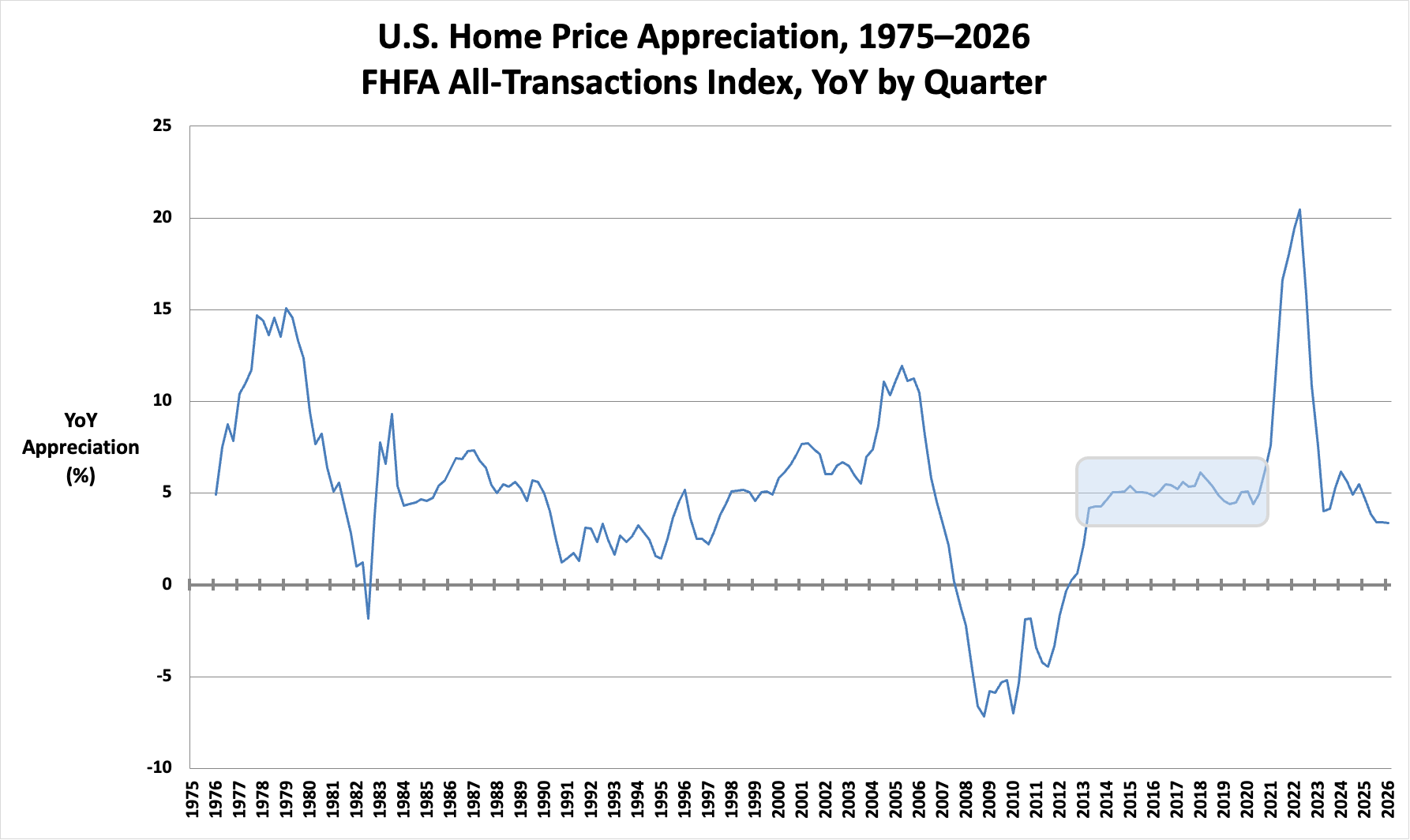
There's also an embedded assumption that home prices only go up. That's looked true in recent years, with appreciation reaching historic levels, but the housing crisis taught us it is not always true. Indeed, the Urban study's loan-performance data cover 2013 through 2021 — a period of nearly uninterrupted price growth — and its equity-building projections assume 3 percent annual appreciation. Nowhere does the report stress-test a sustained decline in home prices, the very scenario that turned high-LTV lending toxic the last time. And rising prices cut both ways: existing homeowners gain equity, even as their property tax bills climb, while prospective buyers watch affordability slip further out of reach if wages do not keep up.
Urban is also correct that coming up with a downpayment — on top of closing costs — is often the single biggest obstacle to homeownership. That's exactly the gap many outside organizations have tried to fill by offering DPA to first-time FHA buyers. But FHA’s history with DPA that was analogous to 100% LTV offers some reason to think through the proposals carefully.
A Cautionary History
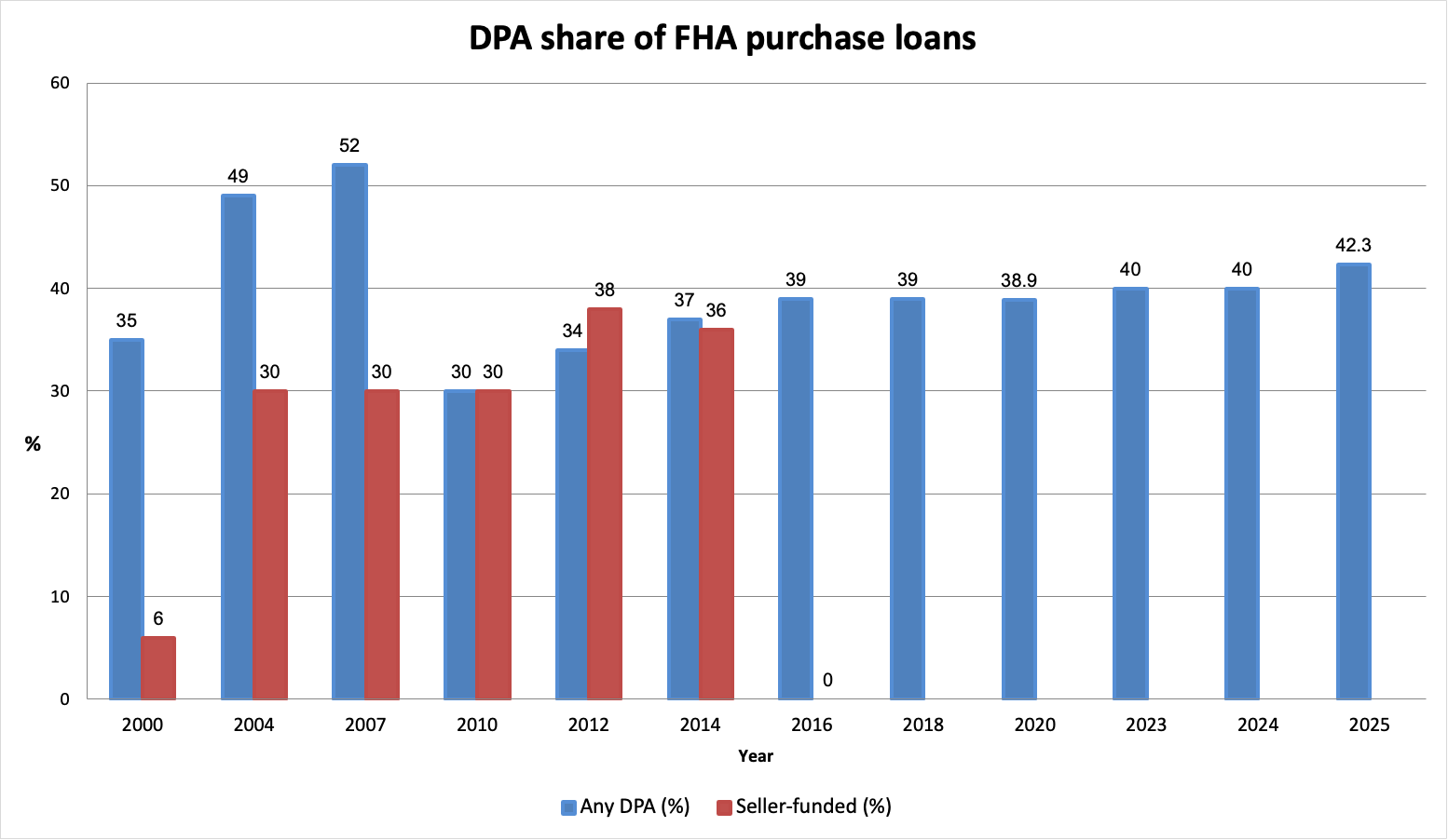
Starting in the late 1990s, a wave of so-called nonprofits began offering FHA borrowers something that sounded too good to be true: a zero-down mortgage. Exploiting a loophole in FHA policy — or lax oversight, or both — these groups aggressively marketed their programs to lenders, builders, and homebuyers. In practice, they fronted the borrower's downpayment and then collected it plus fees from the seller, who folded that amount into the sales price, leaving many borrowers underwater relative to the true home value from day one. By the mid-2000s, nearly half of FHA purchase loans carried downpayment assistance of some kind, and seller-funded downpayment assistance (SFDPA) alone accounted for roughly a third of FHA purchase borrowers — a share still climbing when the practice was finally banned, and one that exceeded half of FHA's purchase business in some states, such as Ohio and Indiana.
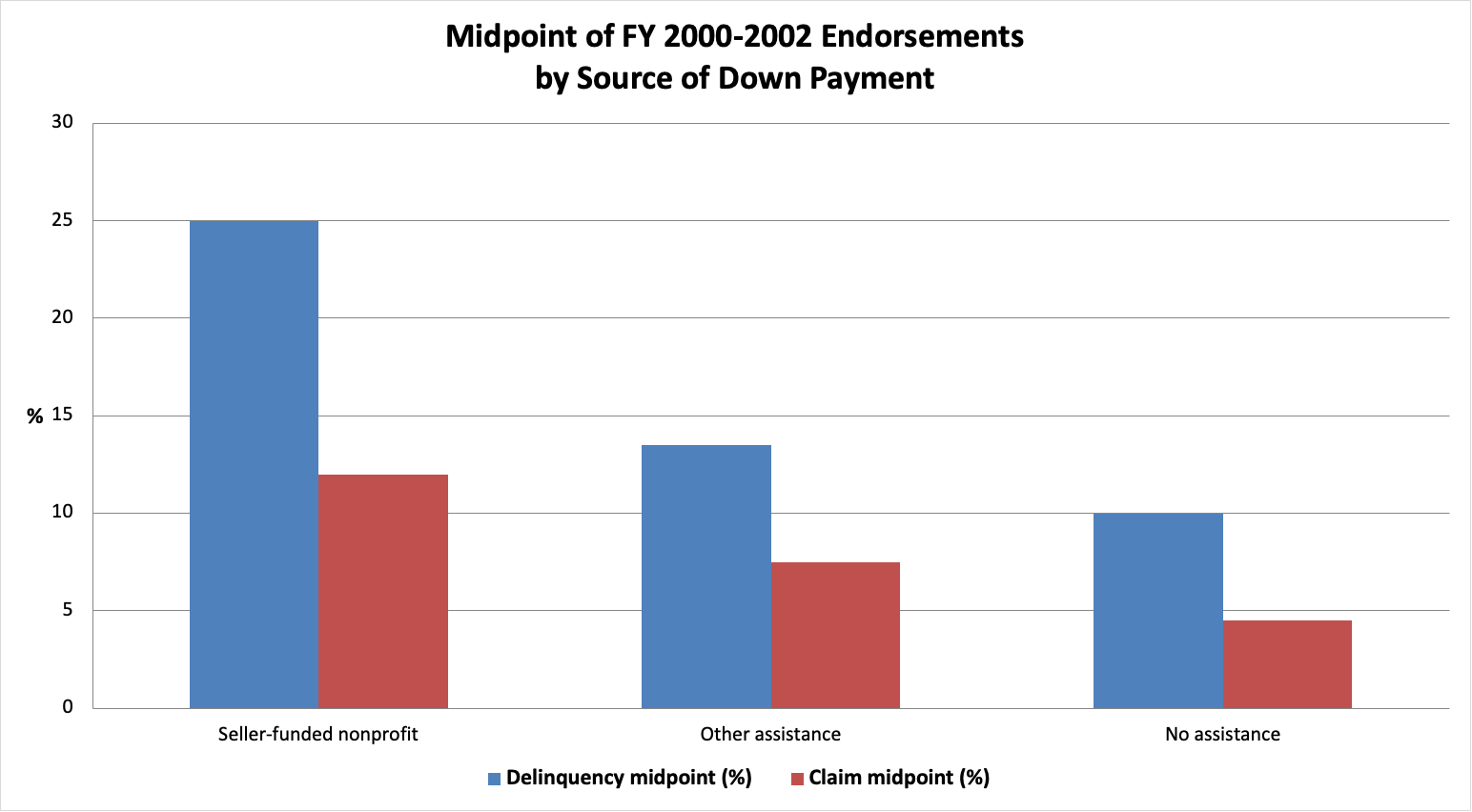
The sales pitch hid a troubling reality. These loans defaulted at roughly two to three times the rate of comparable FHA loans where borrowers put up their own money — even after the Government Accountability Office controlled for differences in borrower and loan characteristics. Even loans backed by family gifts or legitimate government DPA programs underperformed loans where borrowers had genuine "skin in the game."
Notably, Urban's new research reinforces something FHA has observed for a long time: borrowers who put some of their own money into a purchase default less often than those who don't. The Urban authors attribute that gap to who uses assistance — and to depleted savings — rather than to the downpayment itself. That distinction carries much of the weight of their argument, as I will further note below. That said, I've consistently supported downpayment assistance programs run by legitimate government entities — state housing finance agencies and local governments. Their mission is straightforward: help qualified first-time buyers who might otherwise remain renters, while recycling the funds to help the next generation of homeowners. Because much of this assistance is forgivable after several years, such DPA can, all else equal, be an effective way for first-time homeowners to gain equity in their home.
FHA borrowers also tend to have thin financial cushions and less ability to absorb a financial shock. Fannie Mae researchers, examining more than a million actual closing records, found that the median first-time homebuyer leaves the closing table with only about $3,500 in reserves — roughly a month or two of housing payments — and FHA borrowers typically have thinner cushions still. Federal survey data linked to the National Mortgage Database show that borrowers with less than a month of reserves become seriously delinquent at roughly four times the rate of those with several months of savings. FHA’s own annual reports to Congress show that nearly 30 percent of FHA purchase borrowers leave the closing table with less than one month of reserves — which is exactly why underwriting with a tilt toward sustainable homeownership matters so much.
Making matters worse, many of the borrowers who stuck with FHA-backed financing in the mid-2000s were using seller-funded downpayment assistance. Given how poorly those loans performed, we began the process of prohibiting them — a step that, in hindsight, should have come years earlier.
By 2006, with FHA's overall market share sitting below 3 percent, we pushed to modernize the program and restore its relevance to first-time buyers — while separately pursuing formal rulemaking, beginning in 2007, to prohibit seller-funded DPA. Rulemaking is a slow but necessary process, and public comments overwhelmingly backed our efforts.
The modernization effort also included a proposal for a legitimate, FHA-insured 100 percent LTV mortgage under carefully defined conditions — not a repeat of the seller-funded model, but a responsible alternative. It would have used risk-based mortgage insurance premiums to price for the added risk of higher-LTV lending, giving borrowers access to affordable financing while compensating FHA for the risk it was taking on. And we priced that risk accordingly: HUD’s 2004 zero-down proposal carried an upfront premium of 2.25 percent plus an elevated annual premium for the first five years, and the risk-based schedule accompanying the 2006–07 legislation ran as high as 3.00 percent upfront for its riskiest tiers, priced before anyone had seen a national home-price collapse. The bill also included underwriting safeguards meant to protect both borrowers and taxpayers.
The proposal gained broad bipartisan support. The Expanding American Homeownership Act passed the House of Representatives by an overwhelming vote of 415–7 in July 2006, and a successor bill passed the House again in September 2007 by a vote of 348–72. Despite those strong showings in the House, the legislation ultimately failed to advance in the Senate.
Just days before the final rule prohibiting seller-funded DPA was scheduled for release, I attended a local housing industry reception. During the event, I found myself surrounded by representatives of several seller-funded DPA organizations.
Word had apparently leaked that FHA intended to prohibit their programs.
One employee asked me directly whether their organization was “toast.” I responded that they would have to wait a few days and read the final rule.
At that point, another representative—a rather imposing individual—looked at me and said, “Why don’t we go out back and settle this once and for all?”
It was an unmistakable physical threat directed at a public official.
I walked away.
After FHA released the final rule, the seller-funded downpayment assistance organizations sued HUD and sought a restraining order to prevent its implementation. Even more surprising, in March 2008 two federal courts — in Washington, DC, and Sacramento — invalidated the rule within days of each other. Notably, neither court defended the programs themselves; both rulings rested on procedural grounds under the Administrative Procedure Act.
Congress Finally Steps In
Fortunately, at our urging Congress subsequently acted. To settle the legal battles and definitively resolve the issue, Congress stepped in and passed the Housing and Economic Recovery Act of 2008 (HERA) which explicitly prohibited seller-funded downpayment assistance outright. Even so, the law allowed existing programs to keep operating through the end of that fiscal year, despite President George W. Bush signing the bill on July 30, 2008. I was in the Oval Office for that signing — an unusually early ceremony, at 7:05 a.m.
By then, though, much of the damage was already embedded in FHA’s mortgage portfolio and its impact would be felt by FHA for several more years. By FHA's own actuarial estimates, seller-funded downpayment assistance loans ultimately cost the agency more than $16 billion — the 2016 actuarial review put the figure at $16.5 billion. Behind that dollar figure were tens of thousands of families who lost homes and whatever equity they'd hoped to build.
Where This Leaves Us
FHA's history with downpayment assistance — and its own near-miss with 100 percent LTV lending — is a reminder of the balance policymakers must strike between expanding access to homeownership and keeping the program sustainable over the long run.
The Urban study deserves engagement precisely because it is the most serious effort on this question. In several respects, Urban's guardrails — first-time buyers only, meaningful credit standards, a premium surcharge to compensate the insurance fund — echo the framework we advanced two decades ago. My concern is less with the concept than with the evidence now being offered for it, and with what that evidence leaves out.
The Urban study's zero-down performance evidence comes, for example, largely from VA loans — borrowers with steady incomes, residual-income underwriting, and VA's own loss-mitigation infrastructure — an imperfect proxy for the marginal FHA first-time buyer. Its central estimate, that crossing from a 96–99 percent LTV to above 100 percent adds just 12 basis points of default risk, is by the authors' own description “statistically a noisy zero,” with a confidence interval wide enough to contain a full percentage point of additional defaults. Its sizing of the potential market rests on roughly 200 renter households surveyed in 2018. The potential for “adverse selection” is not discussed but a zero-down product, if not priced correctly, would naturally draw borrowers who have little to no savings and limited capacity to build them. And because the proposal would continue to let borrowers finance the upfront premium into the loan, its “zero-down” mortgage would actually begin life at roughly 102 percent LTV — before any seller-paid closing costs are layered on.
A stress test should examine whether any proposed surcharge covers the added risk not only while home prices rise but also in a downturn on the scale of 2008. The deeper point is that savings and equity are not interchangeable. Reserves absorb small shocks; equity absorbs large ones — and we should be careful not to trade the second for the first.
Timing deserves mention as well. FHA serious delinquencies have been climbing, and Urban's own 2025 research attributes the increase in part to borrowers' inability to build emergency savings — precisely the households a zero-down product would newly reach. And as analysts at the American Enterprise Institute have argued, qualifying millions of additional buyers into a starter-home market with thin inventory risks bidding up prices, converting a benefit intended for buyers into a windfall for sellers. Nor is today's healthy fund balance an answer — the fund looked healthy in 2006 too, and premiums were cut in 2015 and again in 2023 precisely because it looked flush.
Defenders of the idea will note, correctly, that VA and USDA already back zero-down loans at scale, and that roughly 40 percent of FHA borrowers today receive downpayment help of some form — with some government-entity programs already pushing effective combined LTVs to 100 percent or beyond. Fair enough. But that only sharpens the real question, which is not whether zero-equity lending can ever work. It is whether this design, priced this way, at this point in the housing cycle, adequately protects both the borrower and the taxpayer.
It is also worth remembering what the 'patchwork' offers at its best: a borrower with a forgivable, non-interest-bearing second carries less debt, pays less each month, and builds equity faster than the same borrower under a zero-down first lien — which suggests the better question is how to extend what works, not replace it.
HERA ultimately established a statutory minimum borrower investment of 3.5 percent, so any true zero-down FHA mortgage today would require an act of Congress — a hurdle the Urban authors acknowledge up front. Given the history here, and the lessons of the housing crisis, it seems unlikely Congress will revisit that requirement anytime soon.
None of this should shut the door to conversations about modern downpayment assistance or new approaches to expanding homeownership. But history is a caution against assuming good intentions alone will produce good outcomes.
Policymakers should approach proposals for expanded downpayment assistance with both an open mind and healthy skepticism. Sustainable homeownership — not just homeownership at closing — should be the goal. Putting borrowers into homes they can't realistically afford to keep is neither sound policy nor a durable path to building wealth.
The challenge for FHA, and for policymakers generally, isn't just helping more Americans buy homes. It's helping them keep them.
+++
THREE QUESTIONS
with Michael J. Marshall, Founding Partner of Gate House Strategies

Marshall is a Founding Partner of Gate House Strategies. Prior to Gate House, he served in leadership roles at HUD, including Acting Assistant Secretary for Policy Development and Research (PD&R), Chief of Staff to the Deputy Secretary, and Senior Advisor at FHA.
QUESTION 1: Spring surveys and recent press coverage suggest the mortgage rate lock-in effect is finally easing. Does the newest data support that view?
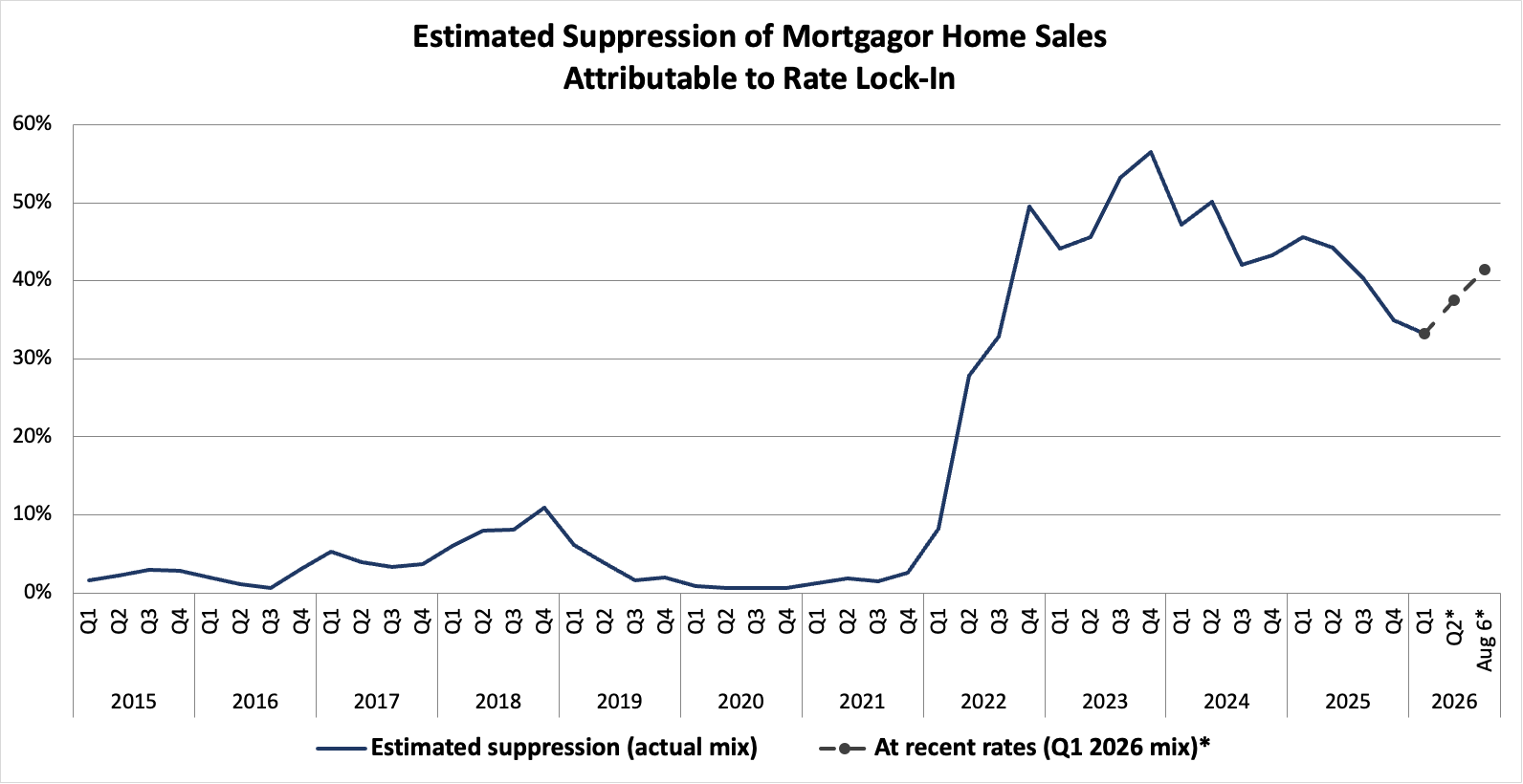
Marshall: Partly — but it matters how the rate lock-in effect is easing, and the newest data show the easing is fragile. Aggregate lock-in can ease in two ways: locked borrowers can exit their low-rate loans (a true thaw), or new loans at market rates can dilute the locked share of the market. Both depend on rates, and at today’s levels only dilution is at work, grinding ahead slowly. Small rate moves still matter, though: the roughly 30-basis-point rise between Q1 and Q2 suppressed about as much home-sale activity in one quarter as turnover had freed up over the prior two years.
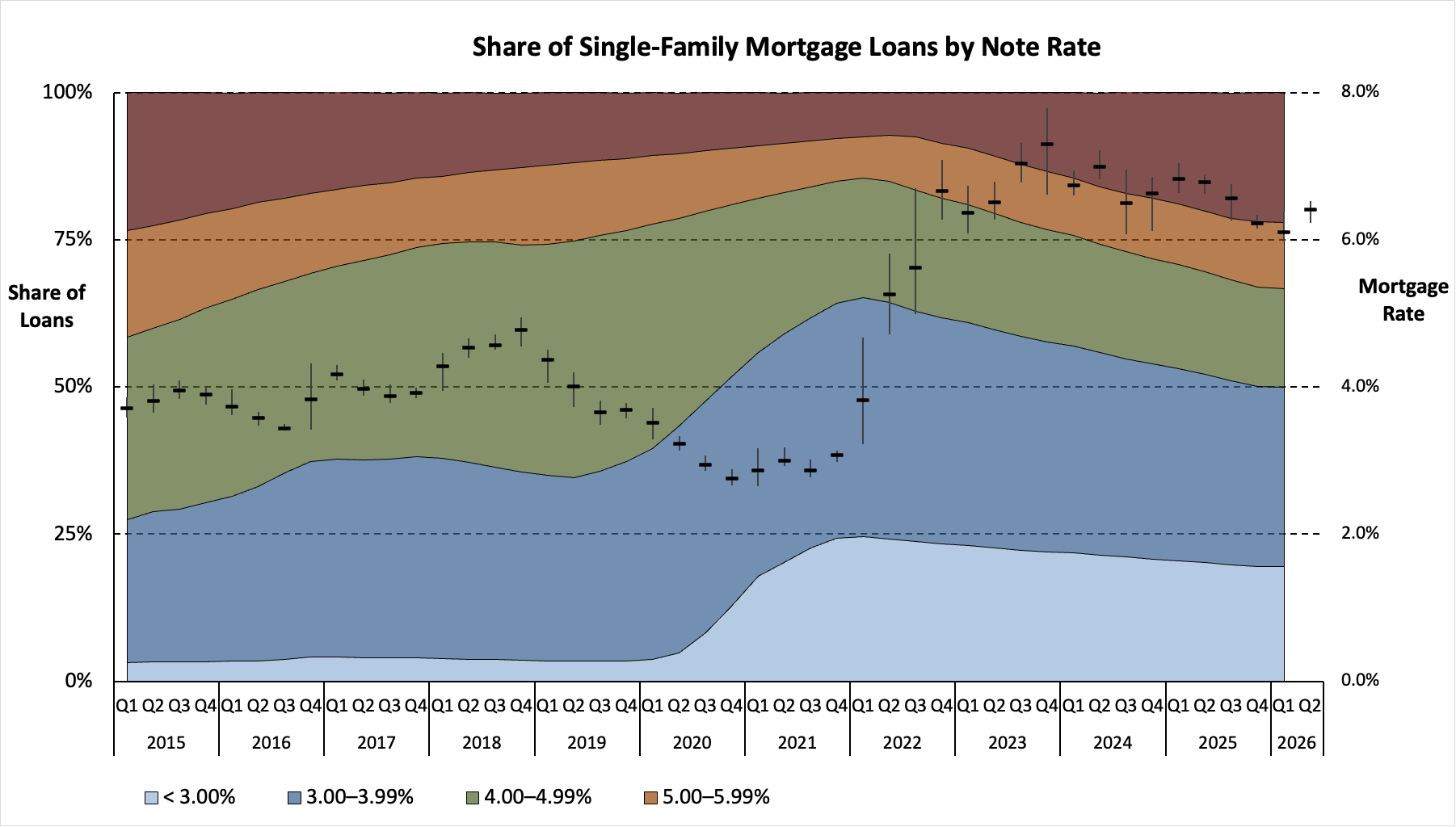
FHFA’s National Mortgage Database (NMDB) shows loans at 4% or more crossed back above half of outstanding single-family mortgage loans in Q1 — the first time since Q3 2020. But the sub-4% share fell just 0.2 percentage points in the quarter, the smallest decline since the unwinding began in 2022, and the sub-3% share did not fall at all. The borrowers with the deepest lock-in have essentially stopped exiting. At the high end, the 6%-plus cohort has grown to 22.1% of loans, its largest share since 2015.
FHFA research estimates that each percentage point of rate differential (current market rate minus existing mortgage rate) cuts a mortgagor’s quarterly probability of selling by 18.1%. Applying that estimate, lock-in reduced the home sales of mortgagors by 57% at the peak in late 2023, easing to roughly 33% by Q1 2026. At the current 6.66% survey rate (Freddie Mac, week of July 30), suppression is back above 40%.
The bottom line: the easing comes in stages. Lower rates would speed up turnover first. Only a material decline would reach the low-rate core and unlock sales by the most locked-in owners — and current forecasts (e.g., Fannie Mae, MBA, CBO) don’t expect one.
+
QUESTION 2: If locked-in homeowners won’t sell or refinance, how has their behavior changed — and how is that reshaping mortgage credit?
Marshall: They are tapping equity through junior liens instead. Second-lien lending hit an 18-year first-quarter high in Q1, and second liens carried 54% of all equity extraction (ICE Mortgage Monitor). And it’s concentrated: nearly two-thirds of Q1 second-lien originations went to borrowers who took out first mortgages in 2020–2022. The same rate gap that suppresses home sales is pushing equity extraction from cash-out refis to junior liens
For a borrower with a pandemic-era loan, a cash-out refi costs thousands of dollars more per year than a HELOC that frees up the same equity. Each cohort is using its lowest-cost option to tap equity: the 2020–2022 vintages overwhelmingly choose seconds, while Baby Boomers, who tend to have older loans with lower balances, took 31% of Q2 cash-out refis vs. just 11% of purchase mortgages (ICE).
For lenders, equity extraction is no longer a refi business that fluctuates with rates, it’s a standing second-lien business for half of the market, and it should keep growing as long as the rate gap lasts.
+
QUESTION 3: What does sustained lock-in mean for the housing market?
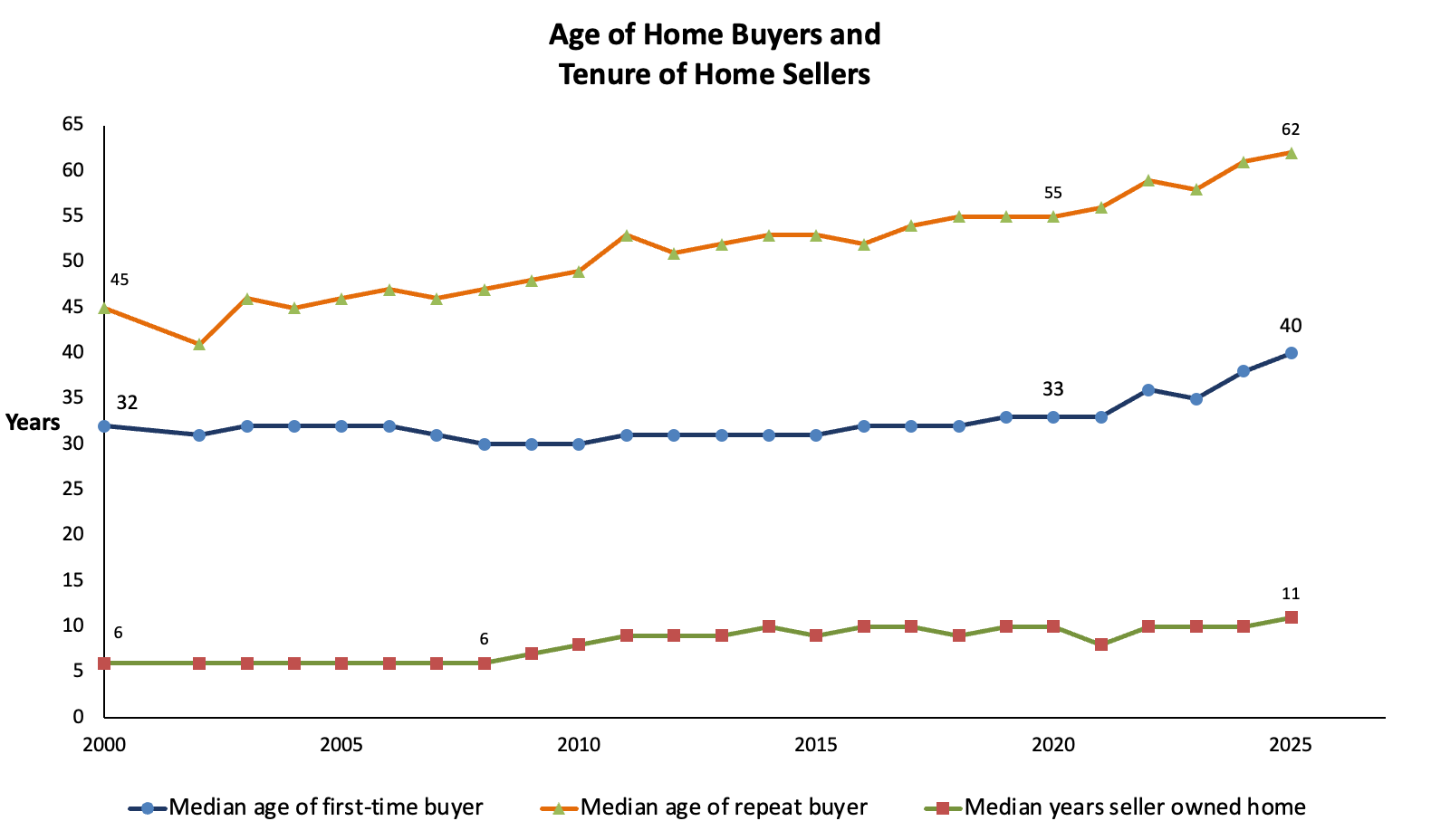
Marshall: Let’s start with a look at housing tenure. Per NAR’s 2025 Profile of Home Buyers and Sellers, seller had owned home a record 11 years before listing, roughly double the pre-crisis norm, and the median repeat buyer is now 62, an all-time high. The mid-life trade-up has largely vanished: owners are aging in place with their sub-4% mortgages, selling only when life events drive a sale. Because deferred trade-ups typically keep lower-priced homes off the market, potential 1st-time buyers face a steeper challenge. The median 1st-time buyer is now 40 years old, a record.
Unfortunately, it appears that homebuilders won’t be able to fill the gap anytime soon. New homes are already plentiful and discounted — 9.3 months of supply versus 4.6 for existing homes, and 37% of builders are cutting prices — but buyer traffic is weak, sentiment has been below 40 for 15 straight months, and builders are trimming future supply. The newly signed 21st Century ROAD to Housing Act targets the right segment, entry-level supply, but its pilots and grants will take years to add homes, and nothing in the law narrows the rate gap that causes lock-in.
Prices, meanwhile, have been roughly flat in 2026, with annual growth of just 1.3% in mid-June (ICE). That flatness is consistent with the two sides of lock-in offsetting each other: withheld supply props prices up while the same high rates hold demand down. FHFA research estimates that from mid-2022 to mid-2024, the supply restriction increased home prices by roughly 7% while rate increases reduced home prices by an estimated 5.6%. How hard lock-in bites will keep moving with rates, but the stock unwinds in only one direction: every quarter of turnover frees more of the market to move. The unwind is slow, but it compounds.
+++

INSIDE VOICES
FHA Moves Toward Partial Claim Modernization:
FHA’s proposed Reinstatement Advance Payment (RAP) framework could represent one of the more meaningful servicing modernization efforts in years. If finalized, the framework would simplify partial claim administration for participating servicers by reducing the need for new subordinate lien recording processes, while preserving FHA’s borrower repayment obligation through a non-interest-bearing balance. The proposal could reduce servicing complexity, administrative costs, and borrower friction. The timing is notable as FHA is experiencing elevated delinquency levels and continued pressure on loss mitigation performance.
+
The ROAD to Manufactured Housing:
The ROAD to Housing Act has elevated manufactured housing as a part of the broader affordability strategy. The next question is less about legislative authority and more about execution: how aggressively will HUD use its existing tools to modernize construction, placement, and financing policies? The policy focus will likely aim to reduce unnecessary regulatory barriers, encourage factory-built innovation, leverage technology, and create more pathways for affordable manufactured housing to reach the market.
+
FHLBs Back in the Housing Finance Debate:
The Federal Home Loan Banks are once again receiving congressional attention, with lawmakers revisiting longstanding questions around mission, governance, affordable housing obligations, and the System’s evolving role in the broader housing finance ecosystem. For traditional mortgage banks, the larger issue is whether policymakers will consider allowing FHLB expansion of membership to independent mortgage banks.
+
CFPB Signals Regulatory Reassessment:
The CFPB is revisiting many aspects of mortgage regulation through recent requests for information and policy reviews. The industry is watching closely for potential changes involving mortgage servicing, disclosures, and compliance expectations. These recent actions relate to the President’s Executive Orders regarding Housing and continue to be a very high priority.
+
Title Modernization Remains on the Radar:
Recent signals indicate that FHFA remains interested in potential innovation in title insurance, while approaching the issue cautiously, emphasizing safety, soundness, and consumer protections. Certain lower risk refinance transactions are a starting point.
+
AI: Vendor Readiness Takes Center Stage:
Fannie Mae’s artificial intelligence governance guidance, effective August 6, represents an important milestone for lenders, servicers, and mortgage technology providers. A key challenge for lenders will be to ensure that third-party providers supporting critical mortgage functions can demonstrate appropriate controls and compliance frameworks.
+
The Long-Term MBS Question:
The Federal Reserve’s balance sheet strategy continues to drive discussion about the future role of the Fed in the agency MBS market. While any reduction in the roughly $1.9 trillion in agency MBS holdings is expected to occur gradually, market participants are considering the longer-term implications of a smaller Federal Reserve footprint. Over time, Fed balance sheet strategy could influence mortgage spreads and funding costs.
+++
THE GATE HOUSE INDEX
The Gate House Index and analysis is designed to provide insight into the status of FHA’s business at a moment in time and over a period of time, as well as other pertinent data points we’re following.
This month, we examine several data points that can inform analysis of the scale and performance of FHA-insured loans with Down Payment Assistance and the status and effects of note rate lock-in on the housing and mortgage markets.
In this first chart, we see that home price appreciation has fluctuated over time. It shows a sustained home price decline during the crisis period, consistent home price growth in every quarter from 2013-2021, and a peak in home price appreciation during the pandemic-era in 2022.
FHA's DPA share hit 42.3% in FY2025, the highest in 16 years and approaching the ~50% peak of the seller-funded era. The zero-down debate is arriving at a moment when reliance on assisted borrowing is already at a post-crisis high.
GAO found claim rates of 6 to 18 percent on loans with seller-funded assistance, versus 3 to 6 percent on loans with no assistance.
Half of all outstanding mortgage loans, 49.9%, have a note rates below 4% in Q1 2026, compared to a market rate near 6.6%.:
Lock-in suppression of existing-owner sales peaked at an estimated 57% in late 2023 and had eased to 33% by Q1 2026 as rates dipped. The relief is rate-sensitive: at the August 6 PMMS rate of 6.69%, suppression rises to 41% even with no change in the loan mix.
The demographic signs of lock-in effects: In 2025, the median first-time buyer is 40 (vs. 33 in 2020); the median repeat buyer is 62 (vs. 55 in 2020); and sellers had owned their homes a record 11 years, about twice as long as the pre-2008 norm of 6. Homeownership is arriving almost a decade later in life, and homes are trading roughly half as often.
+++

This Month In History
France abolishes feudal tenure and creates the modern template for private property in land
In the summer of 1789, France had collapsed into revolution, and the countryside was in open revolt with peasants burning manorial records and refusing feudal dues across whole provinces. The National Constituent Assembly, claiming authority derived not from the Crown but from the sovereign nation it purported to represent, responded by sweeping away feudal obligations in an all-night session on August 4 and declaring in its decree of August 11 that "the National Assembly abolishes the feudal system entirely." The decree severed land from the dues and labor owed to lord and Church that had defined tenure for a thousand years and left behind something new: absolute private property in land that could be freely bought, sold, and mortgaged. Codified in the Napoleonic Code, the property regime was carried across the civil-law world of continental Europe and Latin America by conquest and imitation. The common-law world of England, America, and the Commonwealth took a different path, dismantling feudal tenure piecemeal over six centuries, from the 13th to the early 20th — and English law never abolished the feudal principle at all, with land still held of the Crown in name only. The result is that wherever land is privately held, it is owned, traded, and financed on the same foundation.
FHA+ is published monthly by Gate House Strategies, a Washington, DC area-based advisory firm focused within the financial services, mortgage lending and servicing, community development, and public housing sectors. Contact us at FHAplus@gatehousedc.com