

Issue 18 Includes:
- Think Piece: Brian D. Montgomery on what voters are saying about housing affordability heading into the midterm elections — and why Washington can’t promise a quick fix
- Three Questions: Hunter Kurtz on what the 21st Century ROAD to Housing Act changes for RAD, CDBG and disaster recovery.
- Inside Voices: HUD’s Innovative Housing Showcase, FHA’s proposed Minimum Property Requirements overhaul, new credit scores at FHA and the GSEs, GSE MBS purchases, manufactured home appreciation, AI-enabled permitting, and Matt Jones’ FHA Commissioner nomination.
- Gate House Index: housing affordability heading into the midterms — buyer sentiment, the monthly payment on a new home, renter cost burdens — plus RAD, CDBG and disaster recovery data behind this month’s Three Questions.
THINK PIECE
Voter Sentiment on Housing and Affordability Heading into the Midterm Elections
by Brian D. Montgomery, Founding Partner and Chairman of Gate House Strategies

Brian Montgomery is former Deputy Secretary of HUD and former Commissioner of FHA, the only person to hold that position twice and under three presidential Administrations.
Even with enactment of the 21st Century ROAD to Housing Act, housing affordability remains a key concern among voters. A September Reuters/Ipsos poll found that 47 percent of registered voters cited the cost of living as the most important factor in deciding their midterm vote.
An overwhelming share of respondents to an April Bipartisan Policy Center poll (79%) said the cost of housing is an extremely or very important issue and 89% said they want Congress to work together to increase affordability. In a separate Redfin/Ipsos survey, Americans expressed broad support for tax breaks for first-time homebuyers (79%) and down payment assistance programs (74%).
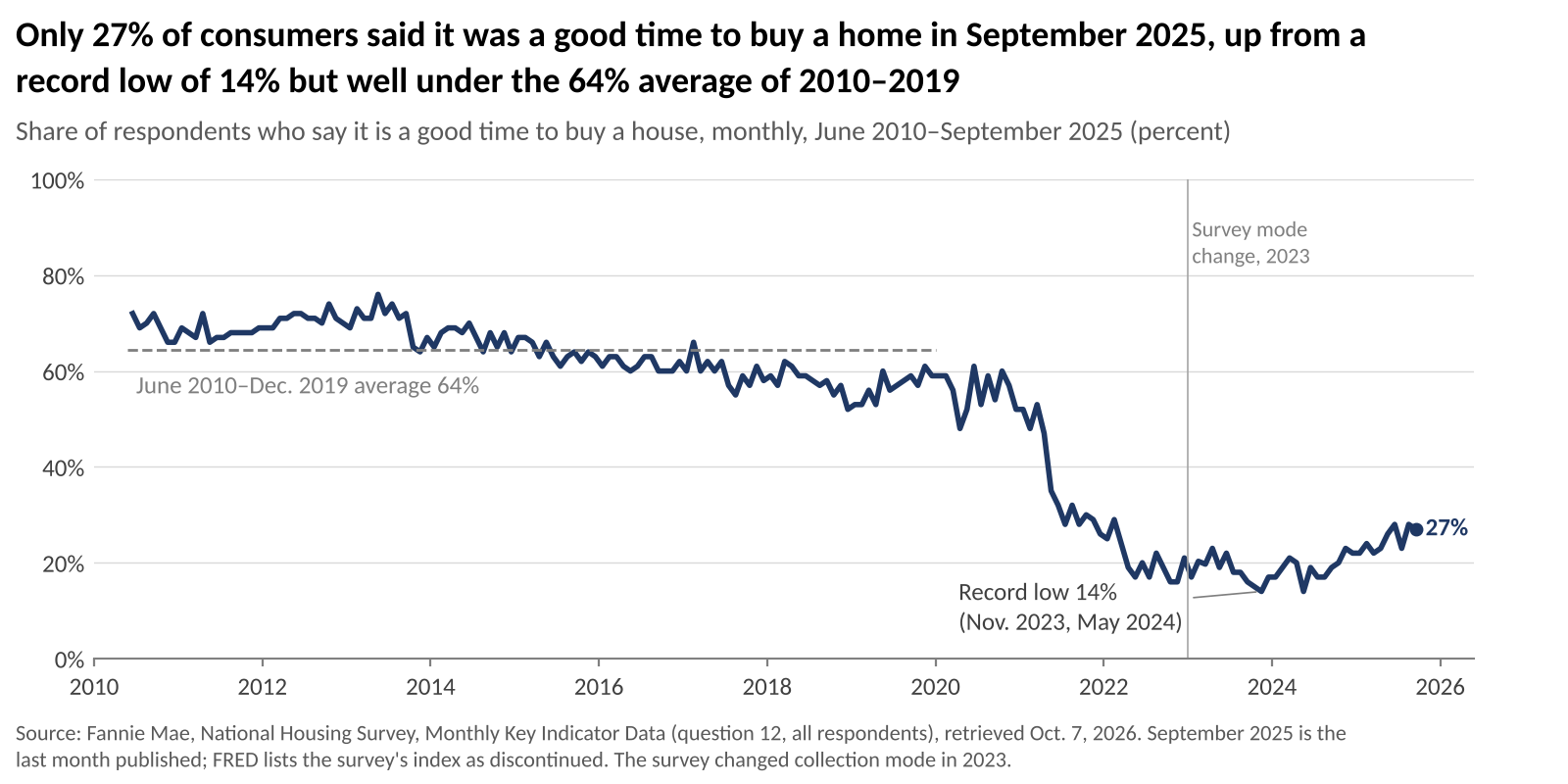
Notwithstanding these heightened concerns, a January National Association of Realtors poll found that 85% of voters still consider homeownership an essential part of the American dream, up from 79% in 2013. That said, only 17% said it was a good time to purchase a home, down from 69% in 2013.
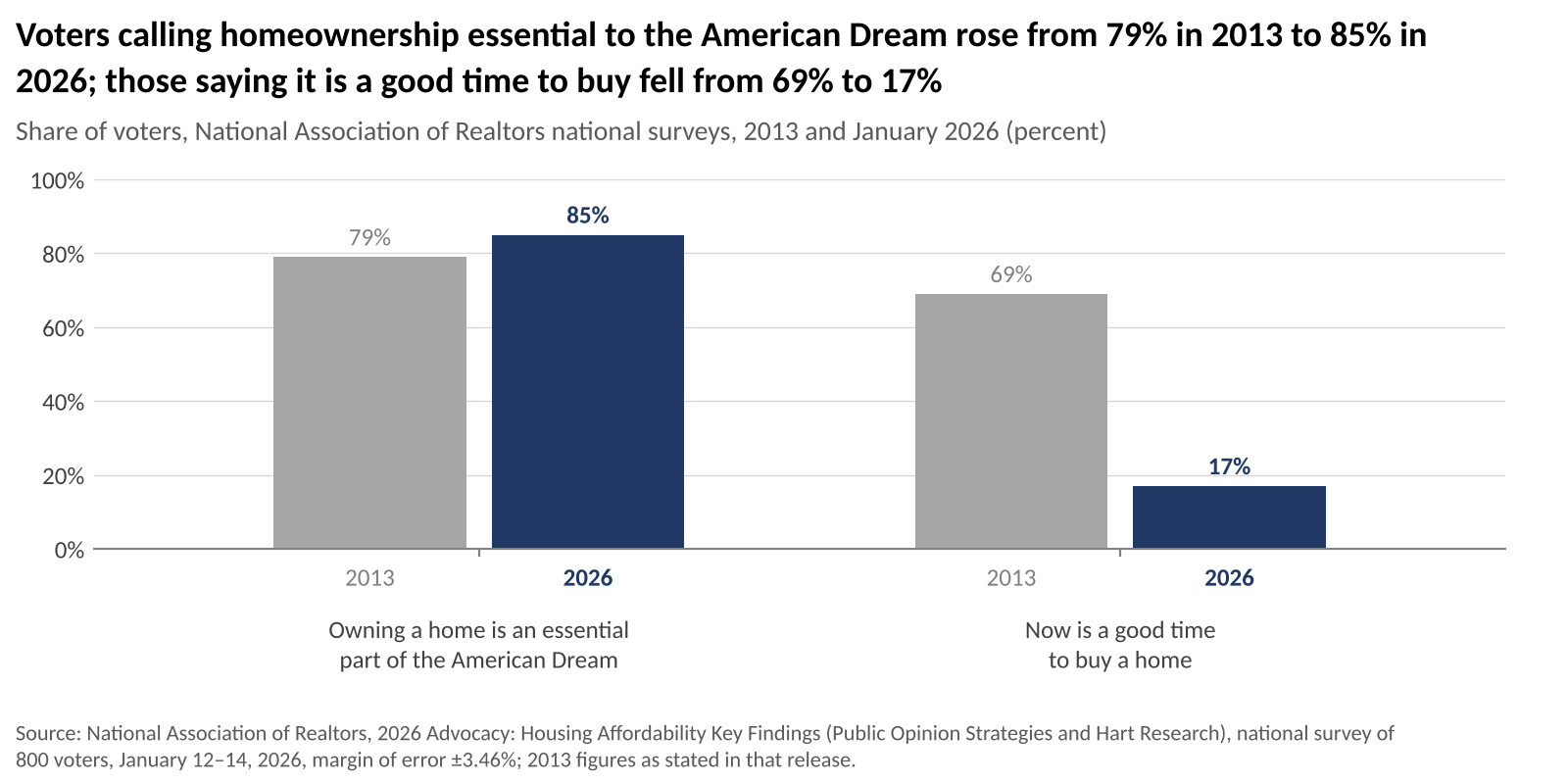
This is a compelling juxtaposition: Americans still care deeply about homeownership, but believe the deck is stacked against them achieving it.
Similar sentiments regarding rental costs were expressed by renters in an October CNBC/SurveyMonkey survey, where 64% said rent caused them the most budget stress. Only 28% of renters and mortgage holders indicated their housing costs were manageable.
While there has been bipartisan support for housing legislation, including the landmark 21st Century ROAD to Housing Act, it’ll be many months or even years before the public sees any meaningful level of implementation, much less increased housing affordability. Its key supply programs are not due until mid-2027, and they are authorized, not funded. So how do candidates on both sides of the aisle respond to voter sentiment on housing?
I think both parties see more opportunities and have recently worked together to solve housing issues; even so, there will be plenty of finger-pointing leading up to the November elections.
Republicans argue:
Government regulation, especially at the local level, excessive fees and costs, restrictive zoning, increasing property taxes and institutional investors have made housing too expensive.
Democrats argue:
Wages haven't kept up with housing costs, and government needs to expand affordable housing, assistance and renter protections.
Both arguments resonate with voters, and across party lines: in the BPC poll, 73% of Republicans and 85% of Democrats called the cost of housing extremely or very important.
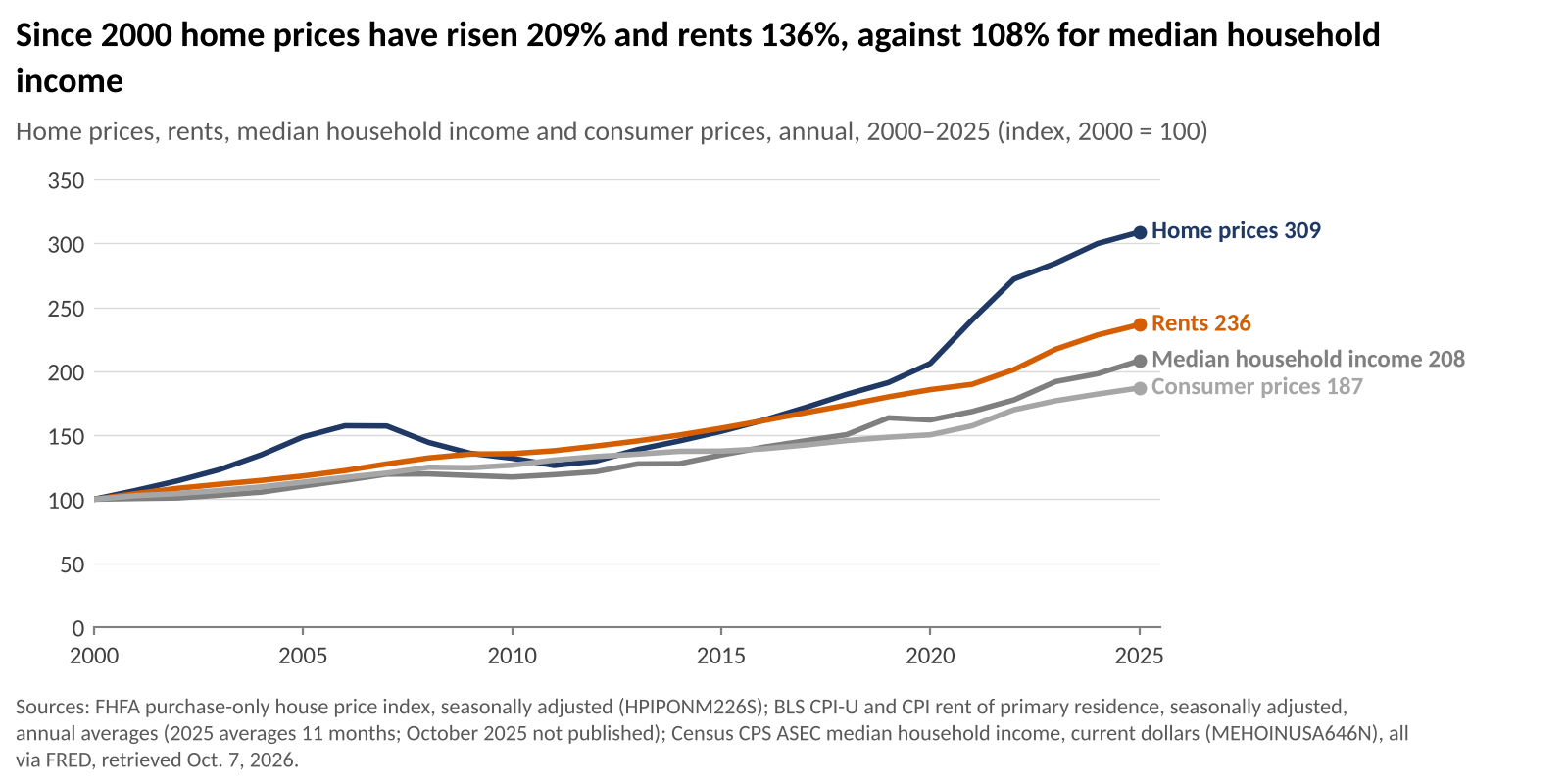
But there is an even more important underlying message:
Voters don't particularly care which federal agency fixes housing. They want their monthly payment to come down.
And that's a difficult problem for Washington because the biggest components—home prices, mortgage interest rates, and homeowners’ insurance and property taxes—aren't easily changed by federal legislation. Washington can trim monthly payments at the margin through FHA and GSE pricing, but it cannot legislate a lower mortgage rate. If there were a silver bullet solution, lawmakers would have used it by now.
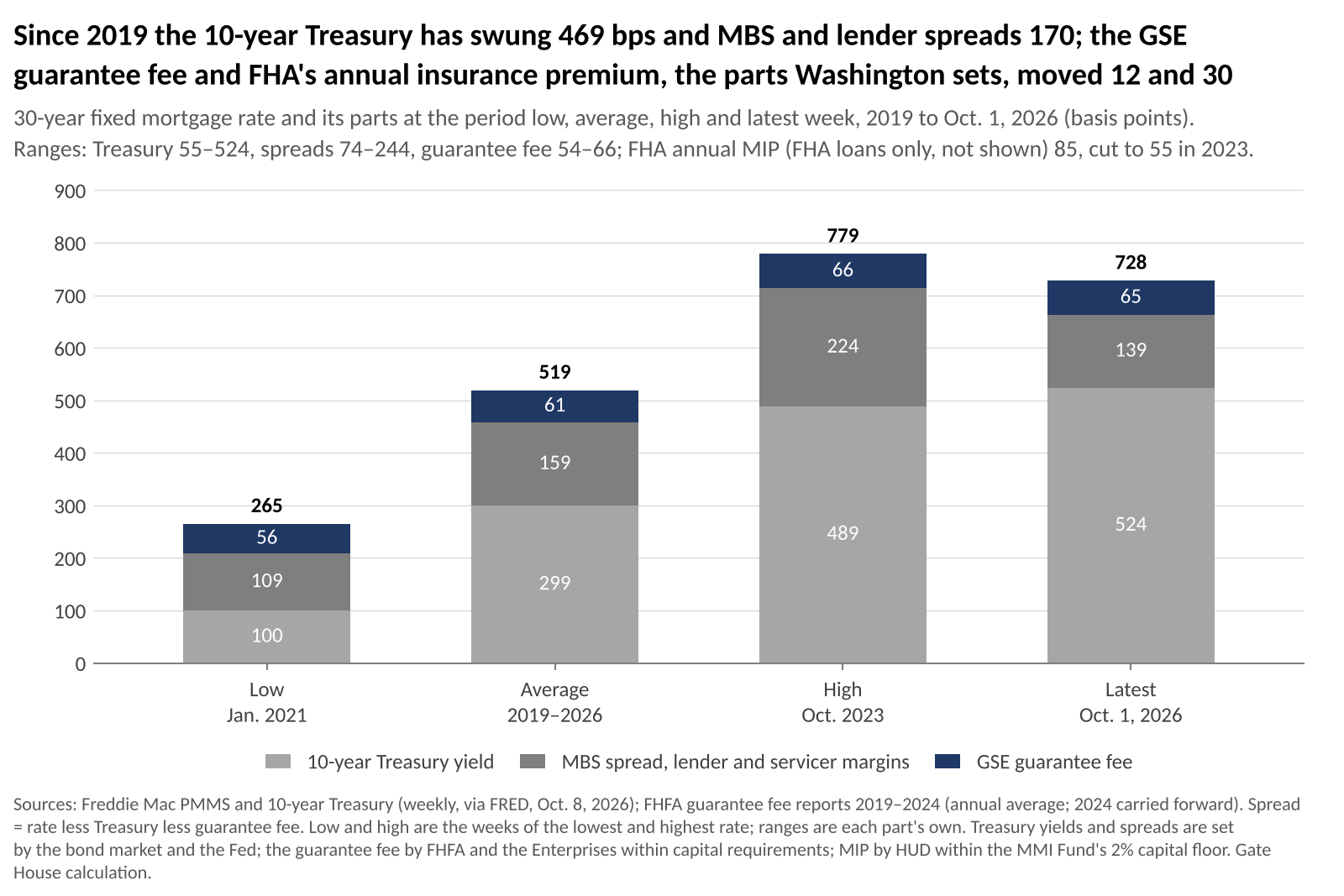
There is also a danger in promising voters that Washington can quickly solve a problem that has developed over decades. Housing supply cannot be created overnight, interest rates cannot be legislated away, and federal assistance cannot indefinitely substitute for the basic economics of building and financing a home.
Policymakers therefore need to focus on the things government can actually influence—encouraging more housing production, reducing unnecessary regulatory barriers, making the development process less expensive and time-consuming, and targeting assistance toward those who genuinely need it.
Expanding access to homeownership is worthwhile, but increasing purchasing power without increasing housing supply can simply push prices higher. The policies voters say they want most are the ones most likely to raise home prices. Down payment assistance and tax incentives can help individual families, but their long-term effectiveness will depend on whether there are enough homes available for those families to buy.
For the industry, the outlook is clear. Candidates in both parties will keep proposing demand-side measures, from tax credits and down payment assistance to buydowns and longer-term or assumable loans, because they poll well. The most direct federal lever on mortgage payments is GSE and FHA pricing, so expect a push for cuts whoever wins. Any cuts would put upward pressure on home prices and come out of FHA and GSE capital. The supply decisions that matter will be made in state capitals and city halls, where the Act’s incentives are aimed.
That is why the most effective housing agenda may ultimately be less about finding a single federal solution and more about aligning federal, state and local policies around one objective: building more homes that Americans can afford.
Housing has an unusual ability to cut across traditional political and demographic lines. It affects young families trying to buy their first home, renters facing higher monthly payments, seniors living on fixed incomes, and existing homeowners confronting rising insurance premiums and property taxes. In that sense, housing affordability is no longer simply a housing-policy issue. It is a pocketbook issue that touches virtually every voter.
Candidates who recognize that reality—and offer practical solutions rather than promising a quick federal fix or simply blaming the other party—may have the most credible message. Voters aren't necessarily looking for Washington to make housing inexpensive. They are looking for policymakers to make it possible again.
The American people haven't lost their desire to own a home. They've lost confidence that they can afford one.
That may be the single most important housing sentiment heading into November.
THREE QUESTIONS
with Hunter Kurtz, Vice Chairman and Founding Partner of Gate House Strategies, LLC

Hunter Kurtz is Vice Chairman and Founding Partner of Gate House Strategies, LLC. He previously served as HUD’s Assistant Secretary for Public and Indian Housing (PIH), leading the industry through the COVID-19 pandemic, and held roles at HUD including Deputy Chief of Staff to the Secretary, as well as Deputy Chief of Staff at the White House Council of Economic Advisers and Deputy Director of the City of Detroit’s Department of Housing and Revitalization.
QUESTION
The 21st Century ROAD to Housing Act impacted a number of important programs that are directly in your wheel house, one of which is the Rental Assistance Demonstration (RAD). What did ROAD change and what is the significance of that for affordable housing preservation?
KURTZ
That’s right. RAD has been one of HUD's more successful tools for preserving affordable housing. It converts public housing units to long-term Section 8 contracts, and those contracts let housing authorities borrow against the properties to finance long-deferred repairs.
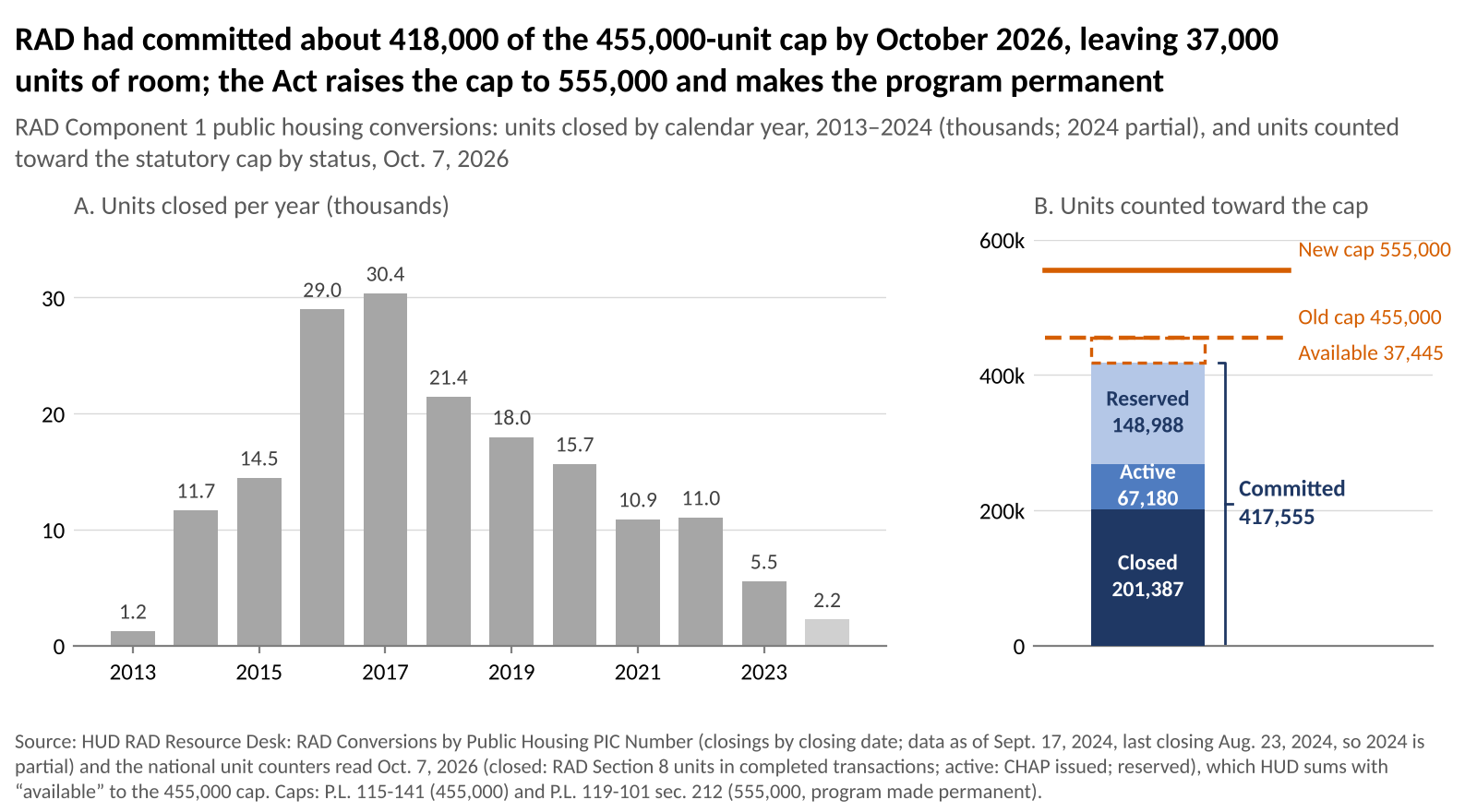
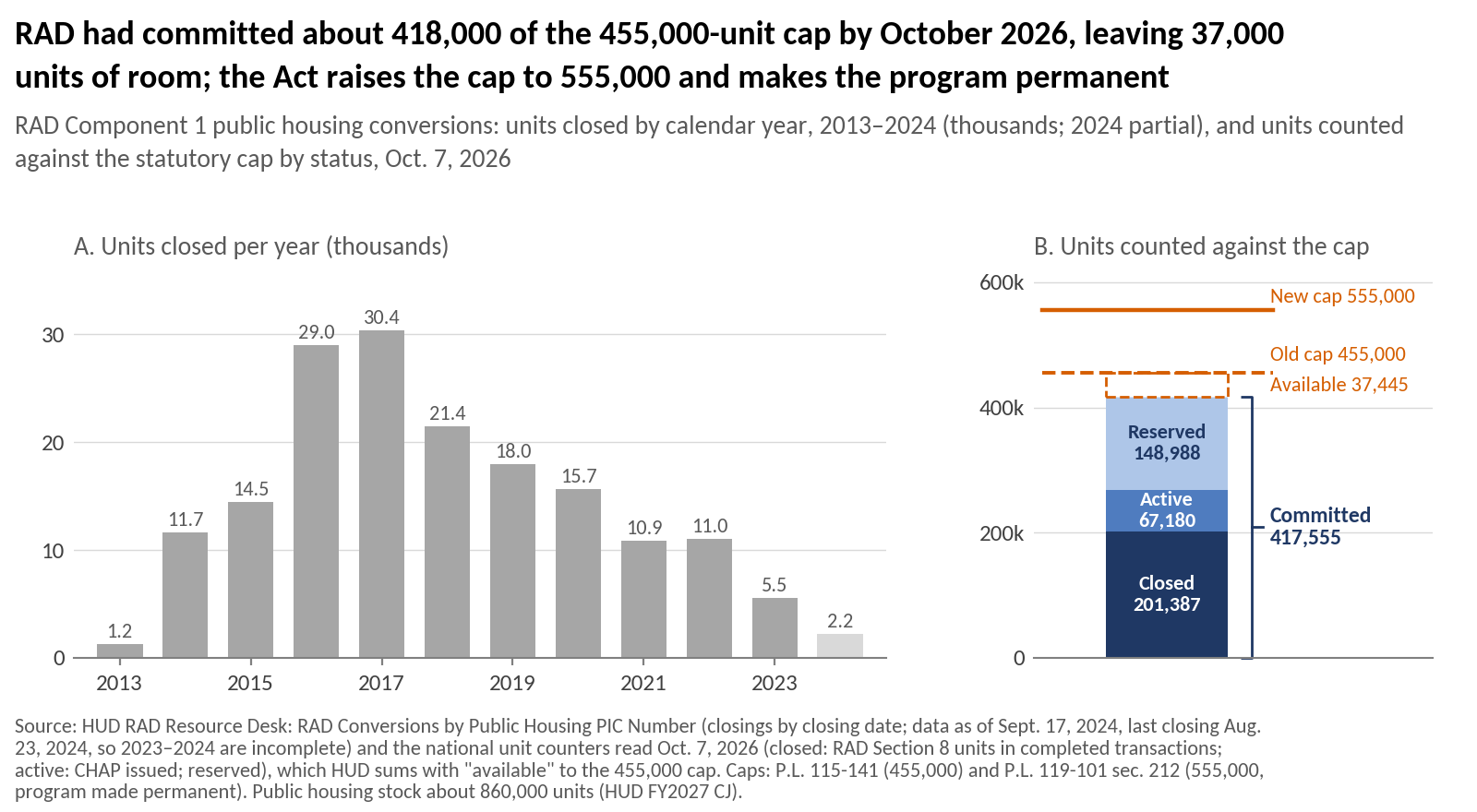
For years the RAD program ran as a demonstration that Congress had to reauthorize through appropriations riders every few years. Section 212 of the ROAD Act makes RAD permanent. The Act also raises the unit cap from 455,000 to 555,000. That matters because HUD counts reserved and active units toward the cap, and about 418,000 of the old 455,000 were already committed.
HUD reports that more than 200,000 units have converted since 2012, and that each dollar of public housing funds has leveraged many more dollars in private and public investment. Because the program is now permanent, lenders and bond financers have a steady pipeline, starting with the roughly 67,000 units HUD lists as active.
QUESTION
For fifty years, CDBG has been one of the most flexible federal grants available to communities, but it could not directly fund new housing construction. What are the most significant changes the ROAD Act makes to CDBG?
KURTZ
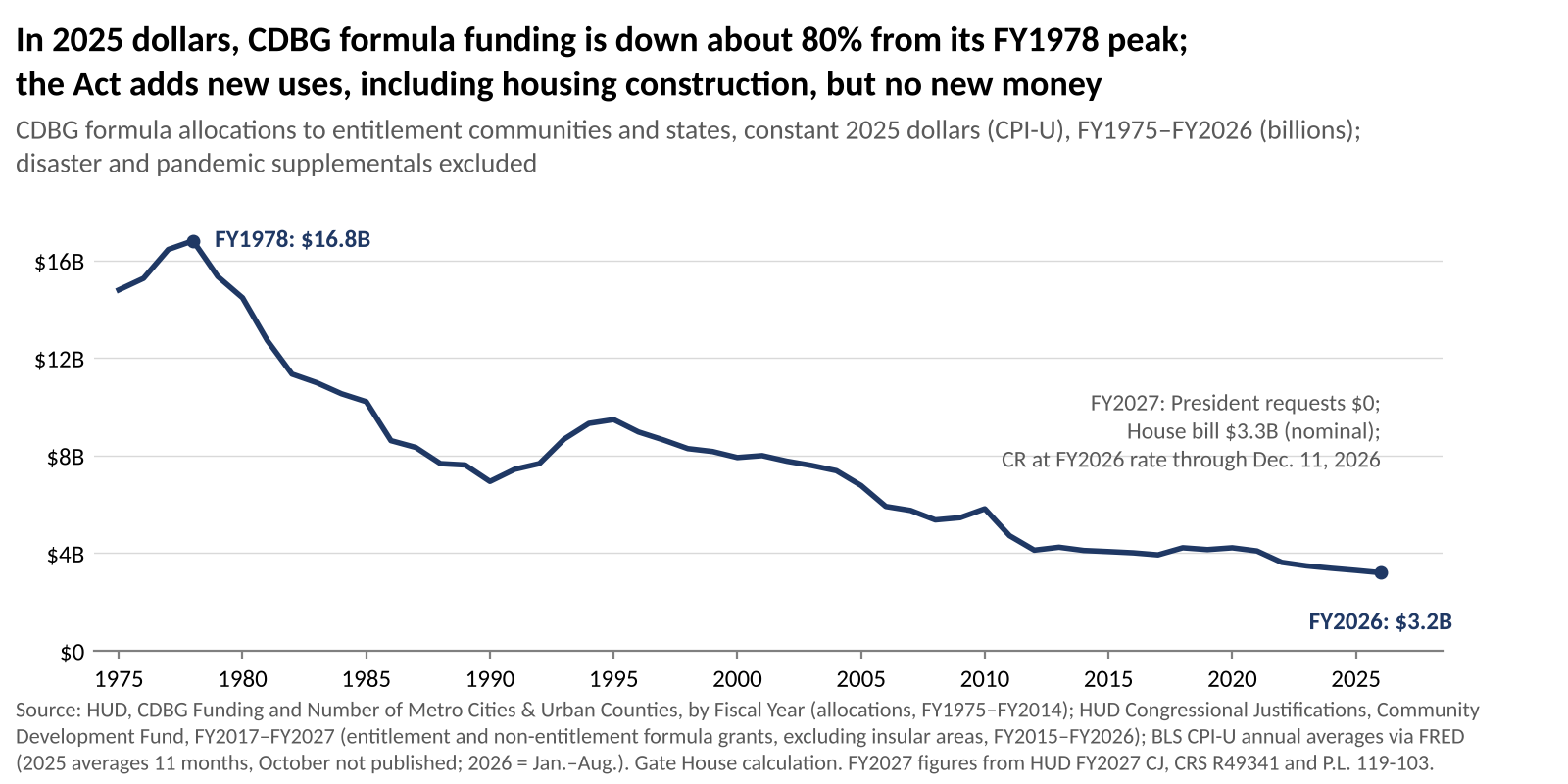
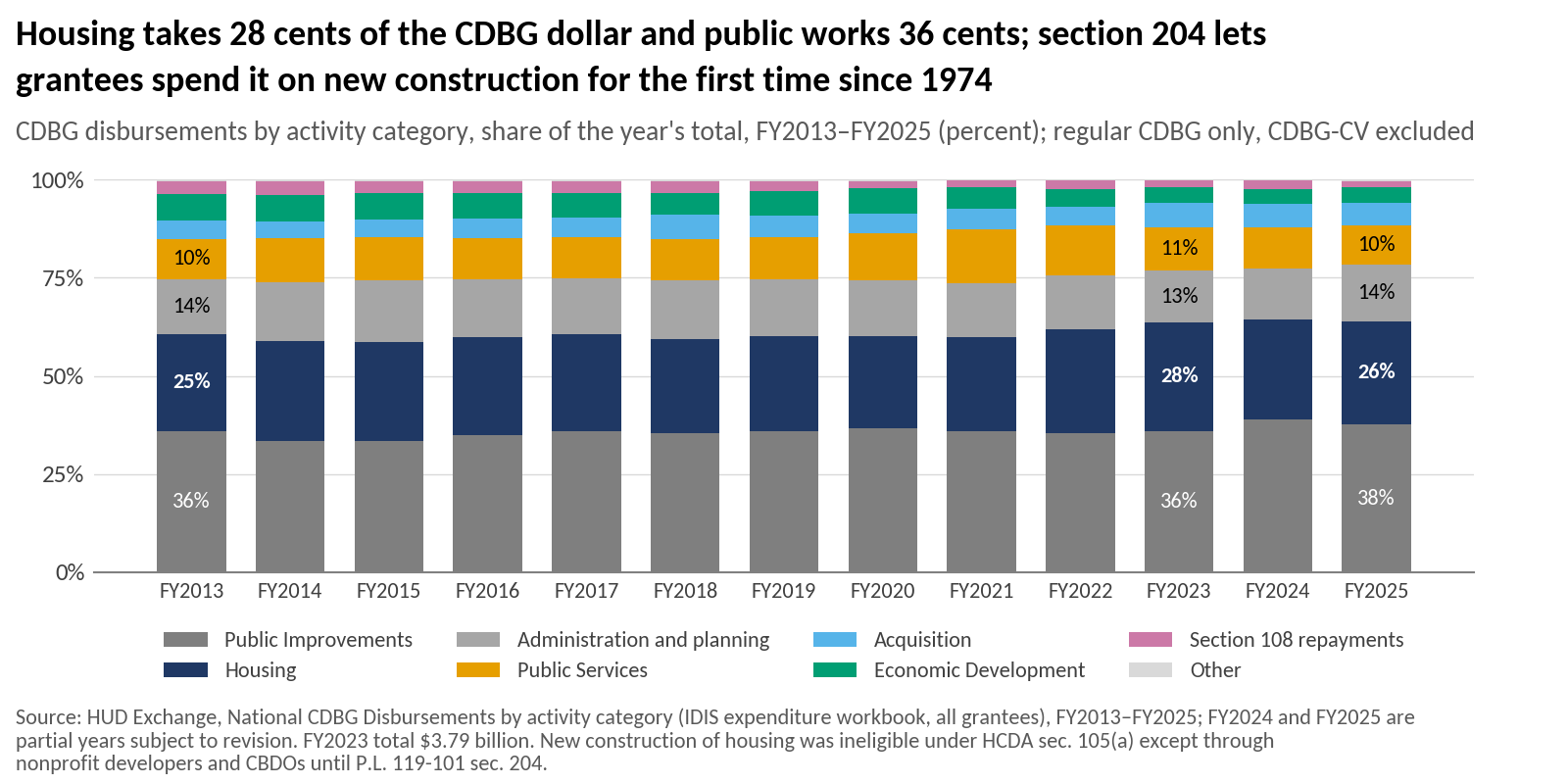
Section 204 lifts a restriction in place since 1974 that barred CDBG from funding new housing construction except through community-based development organizations. Grantees can now use up to 20 percent of their formula money directly for new affordable housing, starting with funds appropriated after enactment. Separately, the "Build Now" adjustments shift formula funds, starting in FY2029, toward jurisdictions where housing growth is accelerating. A good test of whether this matters is the housing share of CDBG spending, which has held at 23–28% for thirteen years. If Section 204 works, that share should rise by FY2028.
QUESTION
CDBG-DR has funded long-term recovery from major disasters for decades, but without a statute of its own. What does the ROAD Act change for disaster recovery, and what should grantees watch as HUD implements it?
KURTZ
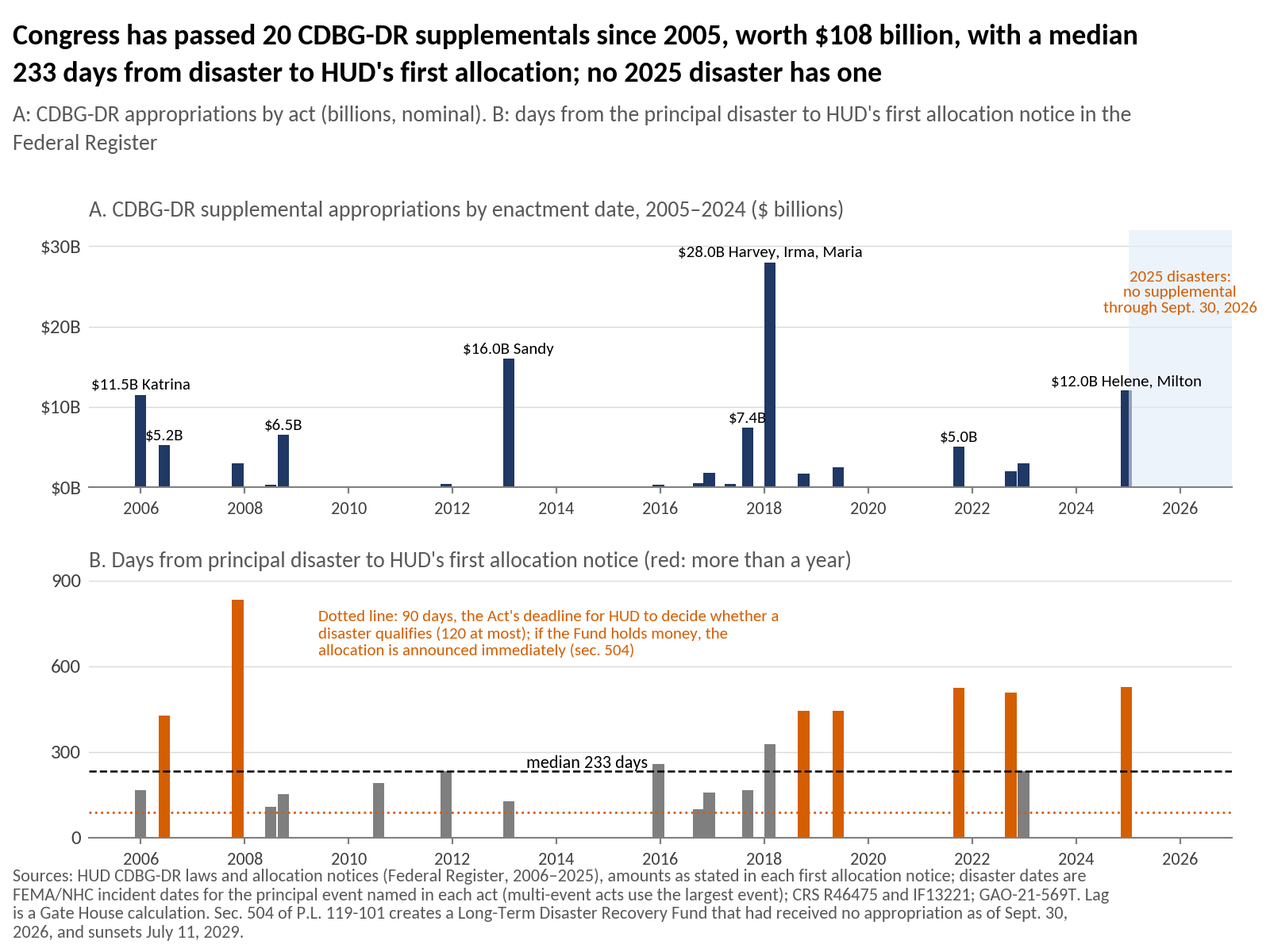
On the disaster side, and this for me may be the most exciting part of the Act, the creation of a DR program. Until now, each disaster's funding came with one-off rules set in a supplemental appropriation. This is important because it allows for consistency in how the DR program will work at both the state and local levels, simplifying the process so grantees know what rules and regulations to expect. Section 504 puts the allocation formula in statute. HUD has 90 days after a declaration to decide whether a disaster qualifies, or 120 if the data are thin, and if money is available, it must announce an allocation immediately. Grantees then have six years to spend their grants, with extensions of up to four years, or six for mitigation. Section 504 also creates a Long-Term Disaster Recovery Fund. That fund can be seeded with new appropriations, CDBG funds recaptured or freed up by sanctions, or unobligated and recaptured balances from earlier disaster grants. Unspent grant funds are recaptured into it, and its money stays available until expended. HUD's proposed rules are due January 11, 2027, and the authority sunsets on July 11, 2029.
Final rules are due by July 11, 2027, and HUD published a CDBG-DR formula notice on August 13. The fund is empty today, so the first real test is whether Congress appropriates into it rather than going back to supplementals with their own rules. The sunset leaves Congress time to revisit the authority once grantees have worked under the final rules.
INSIDE VOICES

HUD Showcases the Future of Housing
HUD’s 2026 Innovative Housing Showcase offered a useful glimpse of where housing innovation is heading. The National Mall display featured manufactured, modular and 3D-printed homes, along with other technologies aimed at expanding supply, reducing construction costs and speeding delivery. Secretary Scott Turner called it a “brilliant display” of what American innovation can accomplish and said the showcased homes could be built in “a fraction of the cost and a fraction of the time.” HUD continues to emphasize private-sector innovation, reducing regulatory barriers and getting more housing from concept to market faster.
FHA Rethinks Minimum Property Requirements
FHA’s proposed overhaul of Minimum Property Requirements is one of the more consequential FHA modernization efforts now on the table. The September 22 draft represents the first comprehensive update of FHA’s MPR framework in more than two decades and would move FHA toward modern industry standards, including greater alignment with GSE property-condition and quality ratings. The proposal narrows certain inspection and repair requirements—for example, limiting lead-based paint repairs to the dwelling structure, eliminating specific appliance, attic and crawl-space observation requirements, updating manufactured-housing installation standards, and removing the requirement to verify public water and sewer connections when local authorities do not require them. FHA is acknowledging that outdated property rules can add cost, delay transactions and discourage sellers from accepting FHA offers—and is asking the industry to help define what truly needs to be required to protect both borrowers and the MMI Fund. Comments are due November 6.
New Credit Scores Coming to FHA
FHA’s September 10 credit-score announcement moves the industry from policy concept to implementation. Beginning January 1, 2027, FHA will permit FICO Score 10T and VantageScore 4.0 alongside Classic FICO for FHA-insured mortgage underwriting. FHA’s TOTAL Scorecard will be updated for case numbers assigned on or after January 1 for Title II forward mortgages, and lenders, credit providers and AUS vendors need to have their systems and processes ready for the new models. Perhaps an interesting question will be how the new models perform in practice. Stay tuned.
Pulte Pushes Credit-Score Transparency
FHFA Director Bill Pulte is taking the credit-score debate another step forward, moving beyond lender choice to greater market transparency. Following the September 9 decision to make VantageScore 4.0 broadly available to all Fannie Mae and Freddie Mac-approved lenders, the Enterprises have released historical data on their proprietary Fannie Score and Freddie Score models. They also previously released historical data for FICO 10T and VantageScore 4.0, giving investors and the broader mortgage market an opportunity to compare how different models perform against actual mortgage credit outcomes. Beginning with October 2026 securities, the GSEs are also adding multiple credit-score model attributes to their MBS disclosures, including Fannie Score, Freddie Score and the model used for pricing. And one more development: on September 30, the Enterprises aligned their loan-level price adjustments across Classic FICO and VantageScore 4.0. The transition to a more competitive credit-scoring framework is moving quickly.
GSE Portfolios Return as an Affordability Tool
FHFA Director Bill Pulte is signaling that the GSEs will again lean more heavily on their retained portfolios as a tool to put downward pressure on mortgage costs. In a September 18 post, Pulte said Fannie Mae and Freddie Mac were beginning to buy “large quantities” of MBS, following several months of declining portfolio holdings. The basic policy thesis is straightforward: additional GSE demand for agency MBS could improve market liquidity and potentially compress the spread between mortgage rates and Treasuries, which could translate into lower mortgage rates for borrowers. The Dallas Fed has likewise emphasized the importance of agency MBS pricing to the rates borrowers ultimately pay. Will increased GSE portfolio purchases become a sustained affordability tool or remain a tactical response to unusually wide mortgage spreads? Time will tell.
Manufactured Housing Defies the Depreciation Myth
Manufactured housing is increasingly challenging the old assumption that it is a depreciating asset—and the opportunity may be particularly interesting in chattel lending. New Realtor.com research found that, from 2019 through early 2026, manufactured homes sold with land appreciated 70.1%, compared with 58.6% for single-family homes; even manufactured homes sold without land appreciated 51.6%. As Realtor.com senior economist Joel Berner put it, the usual narrative is “Don’t buy a mobile home, it will lose value,” but the data says, “Not necessarily.” The results may point to opportunities to modernize FHA Title I to better accommodate the growing chattel-based manufactured-housing market—including financing structures that recognize that the home itself can retain and build value even when the homeowner does not own the underlying land.
AI Takes Aim at Permitting Delays
AI could become an underappreciated tool for lowering the cost of housing—not by changing mortgage rates, but by attacking the time and administrative costs of getting homes built. As housing researchers have noted, states and localities control many of the levers affecting affordability, including zoning, building codes and permitting. Atlanta offers an intriguing real-world example: the city is modernizing its permitting and licensing systems to automate workflows, improve application processing and reduce approval bottlenecks, while final decisions remain with government reviewers. More broadly, cities are beginning to use AI to scan applications, identify incomplete submissions and flag errors before they move into the review process. If AI can safely turn permitting from a repeated cycle of corrections and delays into a much faster process, this could be a game changer.
Two FHA Developments to Watch
Two other FHA developments are worth watching. Matt Jones, HUD’s Deputy Assistant Secretary for Single Family Housing, was nominated in September to serve as HUD Assistant Secretary for Housing and FHA Commissioner. He appeared before the Senate Banking Committee for his confirmation hearing on October 1. Meanwhile, FHA’s comment period on the proposed Reinstatement Advance Payment (RAP) demonstration closed September 18. FHA is now reviewing the feedback and has said it will consider all comments before issuing a final Mortgagee Letter. Both developments could have a meaningful bearing on the next phase of FHA modernization.
THE GATE HOUSE INDEX

The Gate House Index and analysis is designed to provide insight into the status of FHA’s business at a moment in time and over a period of time, as well as other pertinent data points we’re following.
This month, we look at housing affordability heading into the midterm elections: how buyers feel, what a new home costs each month and why, how taxes and insurance have moved, how renters and younger households are doing, and what FHA's data show. We close with the RAD, CDBG and disaster recovery provisions of the ROAD to Housing Act discussed above by Hunter Kurtz. Charts that also appear in the Think Piece or the interview are included here so the data sit in one place.
From the Think Piece: voters still want to own a home but doubt they can afford one. These two NAR readings, thirteen years apart, frame the rest of this month's Index.
Fannie Mae's monthly survey fills in the years between NAR's two readings and shows when confidence broke: in 2021 and 2022, as prices outran incomes. Fannie Mae stopped publishing the survey after September 2025.
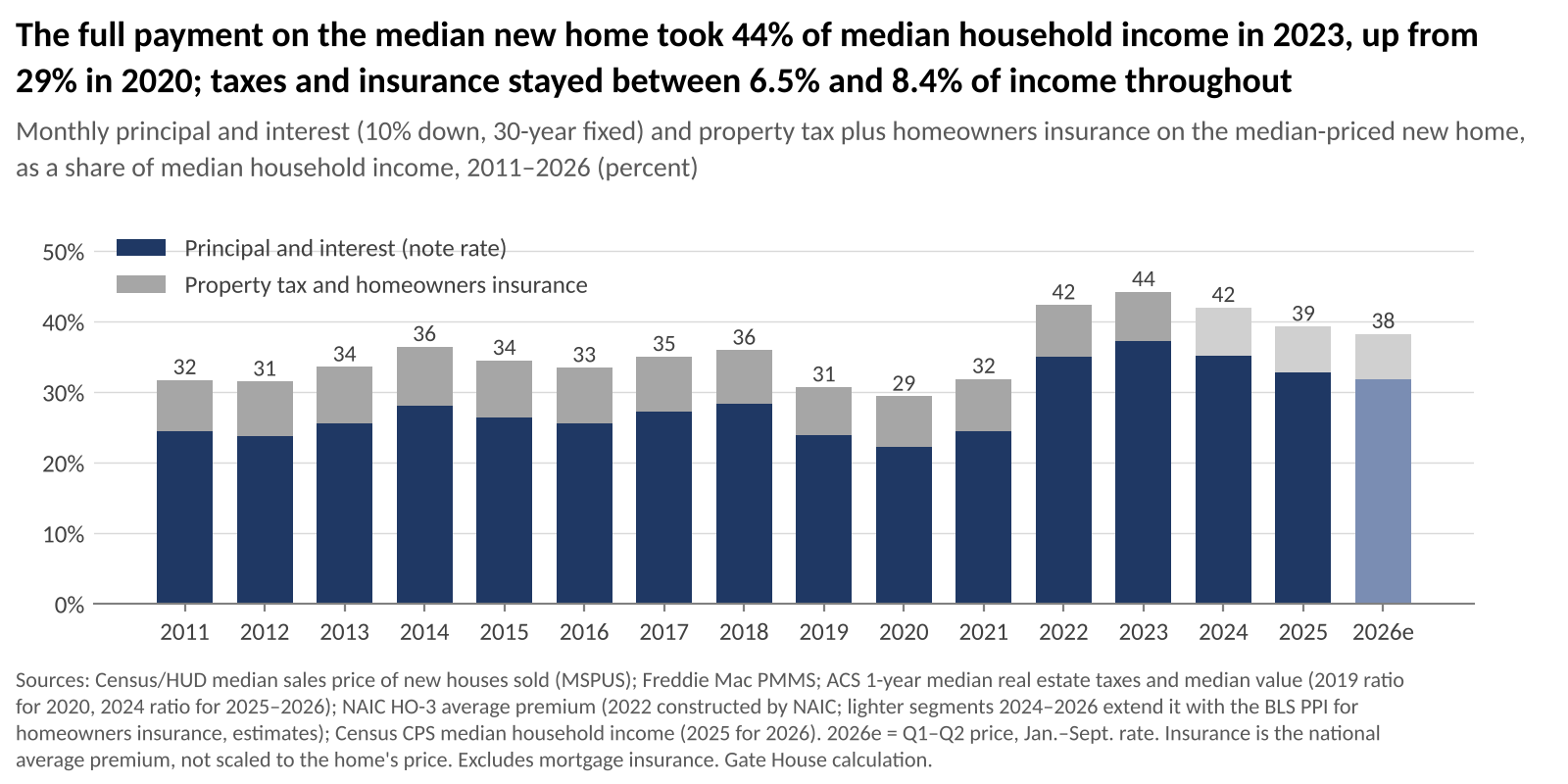
Buyers feel affordability as a monthly payment. This chart splits the payment on the median new home (10 percent down, 30-year fixed) into principal and interest, which depend on the price and the mortgage rate, and property taxes and insurance, which do not. Taxes and insurance have been a steady slice of income; the swings come from the loan itself. At the October 1 rate of 7.28 percent, the 2026 figure would be 41 percent.
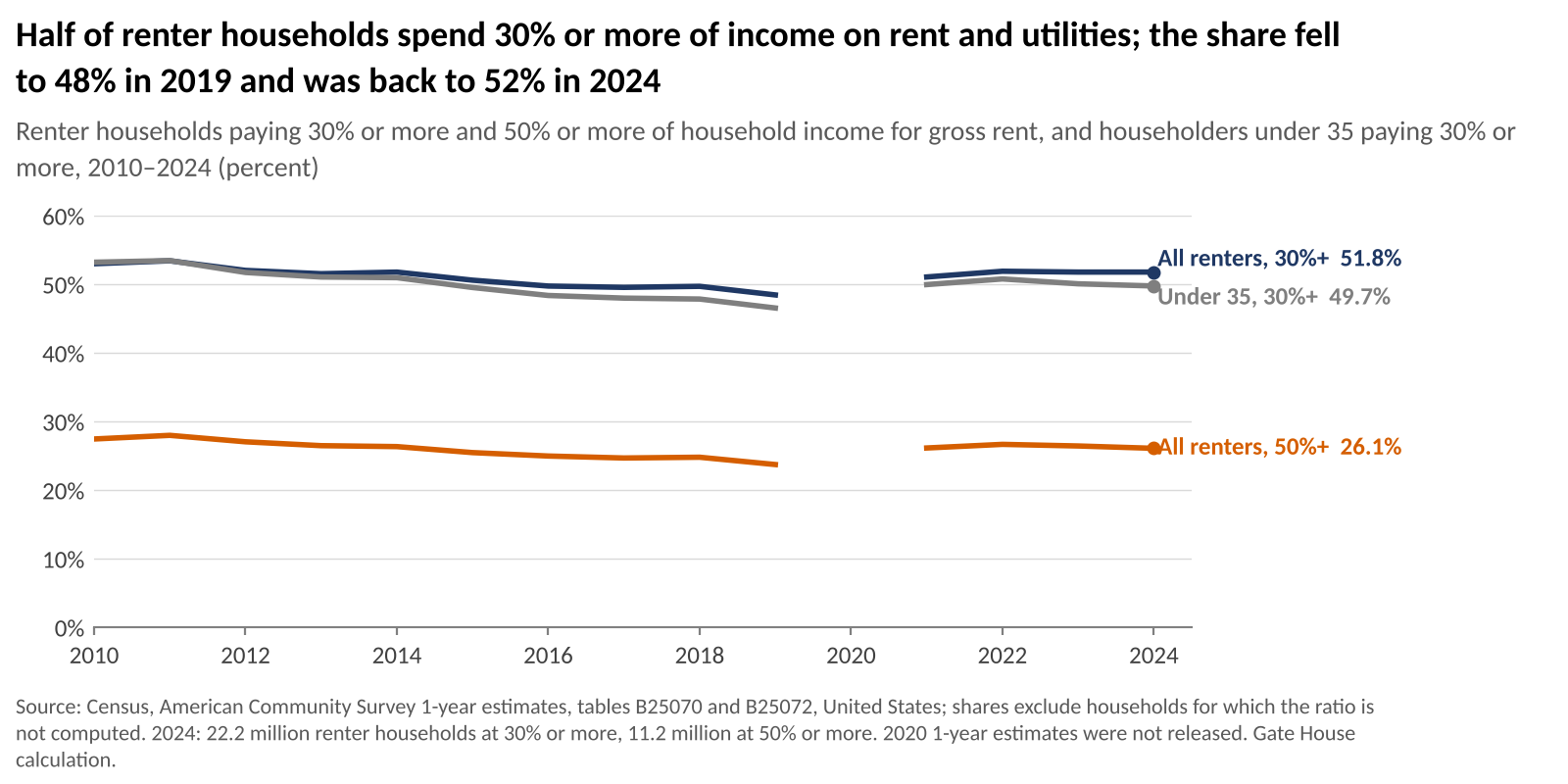
A renter is cost-burdened when rent and utilities take 30 percent or more of income. Half of renters are, about one in four pay more than half of income, and younger renters look much the same. The improvement before 2020 has been undone.
Turning to the topics Hunter Kurtz discusses above. The Act makes RAD permanent and raises its unit cap to 555,000. Most of the old cap was already committed, so the higher cap matters more than the slowdown in yearly closings would suggest.
CDBG is the most flexible federal grant communities receive, and its value has eroded for four decades. The FY2027 budget request would eliminate it; the House bill would hold it near this year's level.
The Act lets grantees spend up to 20 percent of their CDBG allocation on building new affordable housing, so housing's share of CDBG spending is the number to watch.
Disaster recovery money has come through one-off appropriations, each with its own rules and often more than a year after the disaster. The Act sets a standing formula and gives HUD 90 days (120 at most) to decide whether a disaster qualifies, but the new recovery fund is empty and the authority expires in July 2029.
THIS MONTH IN HISTORY

The Tax Reform Act of 1986 creates the Low-Income Housing Tax Credit
The Tax Reform Act of 1986, signed by Ronald Reagan on October 22, created the Low-Income Housing Tax Credit (LIHTC). The Act stripped out the accelerated depreciation and passive-loss sheltering that had driven much of the country's private rental construction. For low-income rental housing, the credit took the place of those incentives: it is allocated by the states, conditioned on long-term rent and income restrictions, and sold through syndication to investors. LIHTC remains the largest source of equity for building and rehabilitating affordable rental housing.
FHA+ is published monthly by Gate House Strategies, a Washington, DC area-based advisory firm focused within the financial services, mortgage lending and servicing, community development, and public housing sectors. Contact us at FHAplus@gatehousedc.com