

Issue 19 Includes:
- Think Piece: Keith Becker on the move to competing mortgage credit scores, FICO’s new pricing program, and potential implications of shifting from tri-merge to bi-merge or single-merge credit reporting.
- Three Questions: Shawn Telford of Cotality on UAD 3.6, the new appraisal data standard taking effect November 2, and what it means for appraisers, lenders, and FHA, plus a bonus question on the future of the appraisal profession.
- Inside Voices: The White House housing-cost Executive Order and manufactured housing task force, FHA’s opening to build-to-rent communities, AI-driven cyber risk, modernizing FHA Title I, and rising escrow advances.
- Gate House Index: How Classic FICO, FICO 10T, and VantageScore 4.0 compare on the same loans, what “highest score” delivery could cost in LLPAs, how many borrowers the new scores would add, and FHA’s outsized share of the UAD 3.6 appraisal transition.
THINK PIECE
Modernizing Mortgage Credit Scores: More Competition, Open Questions About Risk
by Keith Becker, Founding Partner and President of Gate House Strategies

Keith Becker is a founding partner and President of Gate House Strategies, with more than 37 years in the mortgage industry, Becker recently served as Chief Risk Officer for the Federal Housing Administration (FHA).
The mortgage industry is moving toward a more competitive credit scoring environment, but the stakes go beyond which model produces a borrower's score. The Federal Housing Finance Agency (FHFA) and the Federal Housing Administration (FHA) are deciding questions about risk assessment, loan pricing, credit reporting, and access to credit. FICO has introduced a preferred pricing program, FHFA Director Bill Pulte has signaled further action to ensure genuine competition, and Fitch Ratings is examining how alternative scores should be treated in mortgage-backed securities (MBS) ratings.
From a Single Score to Multiple Models
For decades, mortgage lending relied on Classic FICO, drawn from reports at all three national bureaus (a "tri-merge"). FHFA approved FICO Score 10T and VantageScore 4.0 for Fannie Mae and Freddie Mac (the GSEs) in 2022, but implementation has been slow. After postponements in early 2025, FHFA in July 2025 allowed lenders to use either Classic FICO or VantageScore 4.0 while keeping tri-merge.
The pace picked up in 2026. The GSEs began accepting VantageScore 4.0 in April, FHFA removed the prior-approval requirement in September, and on September 30 the GSEs announced aligned loan-level price adjustments (LLPAs) for both models, effective October 1. FHA will accept the new models beginning January 1, 2027, through its own TOTAL Mortgage Scorecard.
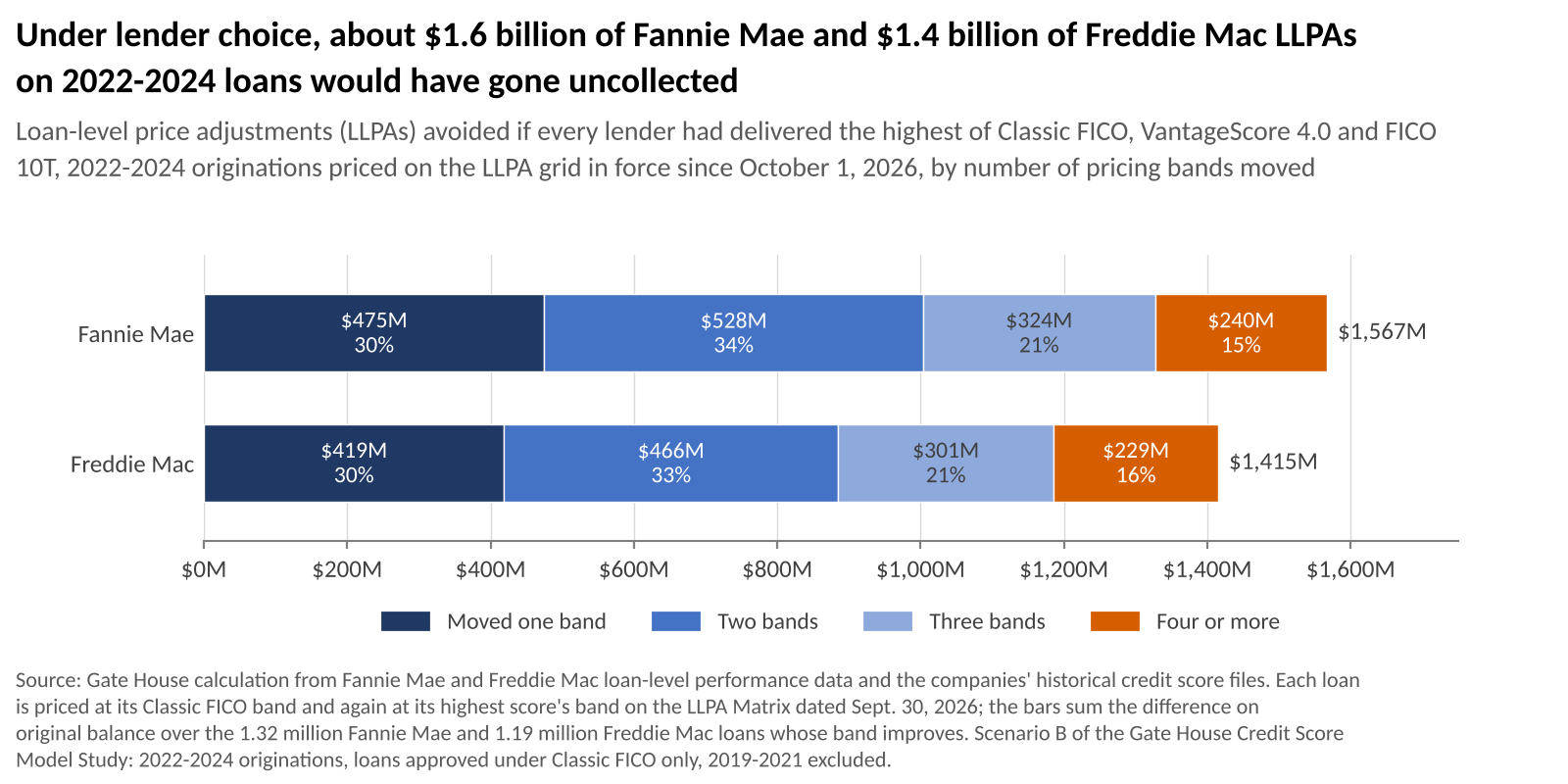
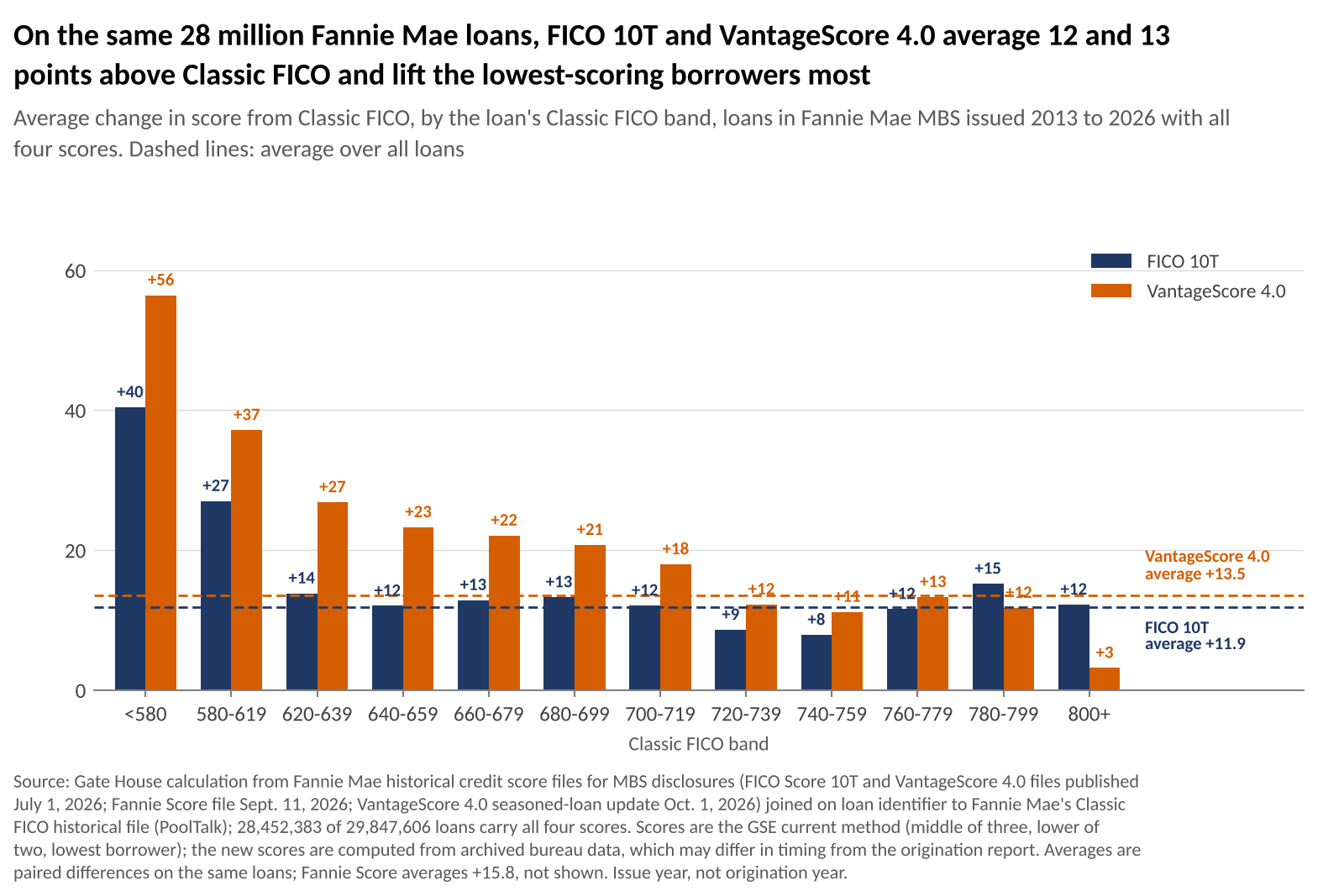
Lender choice also raises the delivered score. On the same loans, VantageScore 4.0 and FICO 10T run about 13 and 12 points above Classic FICO respectively for GSE loans. If all lenders had delivered the highest of the three on 2022-2024 originations, about 45% of loans would have landed in a cheaper LLPA row. Based on the current LLPA grid, LLPAs would have declined over the three years by about $1.6 billion at Fannie Mae and $1.4 billion at Freddie Mac. (See the Gate House Index for more.)
Approving competing models does not guarantee competition in practice. Lender contracts, reporting arrangements, and secondary-market requirements will determine whether borrowers see any savings.
The Emerging Pricing Contest
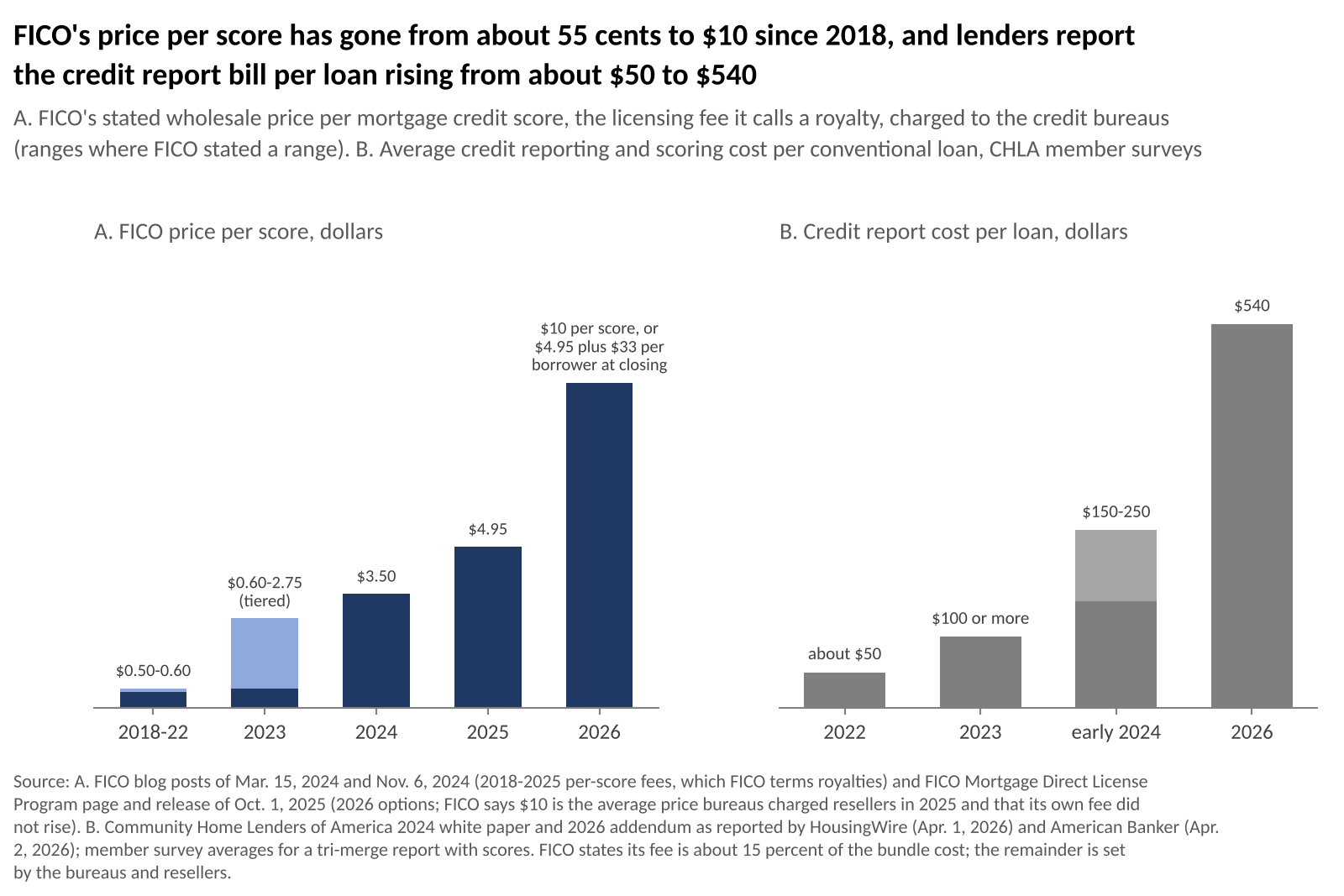
FICO's October 23, 2026 announcement shows the pressure on scoring providers. FICO will hold its wholesale mortgage score price at $10 for lenders in its Preferred Program, which bundles Classic FICO and FICO 10T through tri-merge resellers. Enrolled lenders, however, must obtain FICO scores on all applications, including soft and hard pulls.
This is not an unconditional price cut. A lender that keeps buying VantageScore while committing to FICO on every application could pay more. It also rules out pulling a cheaper VantageScore first and ordering FICO only when needed.
Pulte's October 26 statement that FHFA was taking further action to ensure competition was genuine rather than manipulated suggests scrutiny of practices and market structures, not just prices. The scope is unclear, but the challenge is to distinguish legitimate competition from arrangements that limit its benefits.
The Next Question: Bi-Merge or Single-Merge Reporting?
FHFA previously contemplated two bureau reports instead of three, postponed the change, and has set no timetable. Whether the industry moves to bi-merge, a single-merge, or stays with tri-merge deserves careful study. Fewer reports could lower origination costs, but those savings must be weighed against less complete information and inconsistent outcomes.

Scores. Each bureau scores the same person slightly differently, partly from real differences in the data and partly from noise. Today the lender uses the middle of three scores, which smooths the noise. Under a two-bureau rule, the lender would use the lower of two, which tilts scores downward. As a rough, illustrative estimate, if bureau scores typically differ by 10 to 12 points, the lower of two would run about 5 to 7 points below the middle of three. Borrowers near a cutoff, such as 620, could be priced worse or lose eligibility, and LLPA grids calibrated to middle-of-three scores would need recalibration to avoid an unintended price increase.
Credit quality. The effect on loan performance is probably modest. Applying today's criteria, the lower of two is more conservative on average, so performance should hold steady or improve slightly. The GSEs' underwriting systems also rely on their own models, which may further limit the effect, but that should be tested rather than assumed. The bigger concern is accuracy. Part of the score drop is noise, not risk, so some good borrowers would be penalized without screening out many bad ones.
Information lost. A third bureau occasionally shows debts, collections, or accounts the other two miss, which matters most for borrowers with undisclosed obligations and thin files, and it provides a check on identity fraud. A single pull is the weakest option: it has no cross-check on errors, invites lenders to choose the most favorable bureau unless one is designated, and concentrates risk in one bureau.
A split market. FHA has stated its intention to keep tri-merge, reasoning that it gives the fullest picture of a borrower's credit and protects borrowers at the margin. If the GSEs move to two bureaus, conventional loans would use the lower of two while FHA loans stay with the middle of three. Lenders doing both would run two processes, eroding savings. A 625 middle score could fall below 620 on the lower of two, leaving the borrower ineligible or priced worse conventionally while FHA remains available. That could push marginal borrowers toward FHA, shifting risk toward the FHA and Ginnie Mae side. FHA borrowers skew toward lower scores and thinner files, so they would be among the most exposed if a bi-merge were ever applied to them.
Mission. If bi-merge or single-pull reporting mainly lowers costs for borrowers with stronger profiles or more equity, it could make credit less accessible, or risk assessment less reliable, for those who need the most careful evaluation. Modernization should be judged not only by savings but by who benefits and who is left behind.
Fitch and Alternative Scores
In October 2026, Fitch sought industry feedback on whether alternative scores, combined with other loan and borrower characteristics, could be used to derive an "equated" Classic FICO score for its MBS rating model. This is a request for feedback, not an adopted methodology, but it shows that a score acceptable for underwriting is not automatically interchangeable for analysis. It is premature to say whether alternative scores will raise or lower ratings. What is needed is transparent methodology, performance evidence, and clear disclosure of which model was used.
A Risk-Based Path Forward
Competition among scoring providers is valuable, but lower costs and greater flexibility are not, by themselves, evidence that a change improves the system. Policymakers should track actual performance data, including approval rates, delinquency performance, and outcomes when two versus three bureau reports are available, with particular attention to borrowers with limited credit histories.
Three distinctions should guide the work. First, which scoring model to use is separate from how much credit information to collect, and expanding model choice does not require reducing the number of bureaus. Second, the cost of obtaining a score is not the cost of managing credit risk, and a change that lowers one may raise the other. Third, those effects should be measured, not assumed.
Mortgage credit policy must balance competition, affordability, access, and safety and soundness. The goal should be more accurate, transparent, and inclusive risk assessment. If bi-merge or single-pull reporting mainly lowers costs for stronger borrowers while making risk assessment less reliable for those who need the most careful evaluation, it fails that test.
THREE QUESTIONS
with Shawn Telford, Chief Valuation Officer, Cotality

Shawn Telford is Chief Valuation Officer at Cotality (formerly CoreLogic), which he joined in 2007. He has worked in the appraisal field since 1993, with experience spanning mortgage lending, collateral management and valuation technology, and is a member of the Appraiser Qualifications Board and a past member of the Appraisal Standards Board.
UAD 3.6: Modernizing the Data Behind the Home Appraisal — Three Questions, Plus a Bonus
This month’s Three Questions comes with a bonus. After covering what UAD 3.6 is, how adoption is going, and what it makes possible, Shawn Telford takes on a fourth question: what the transition means for the appraisal profession.
The appraisal is familiar to most people in housing finance. The data infrastructure behind it, however, is far less visible—and likely far less familiar.
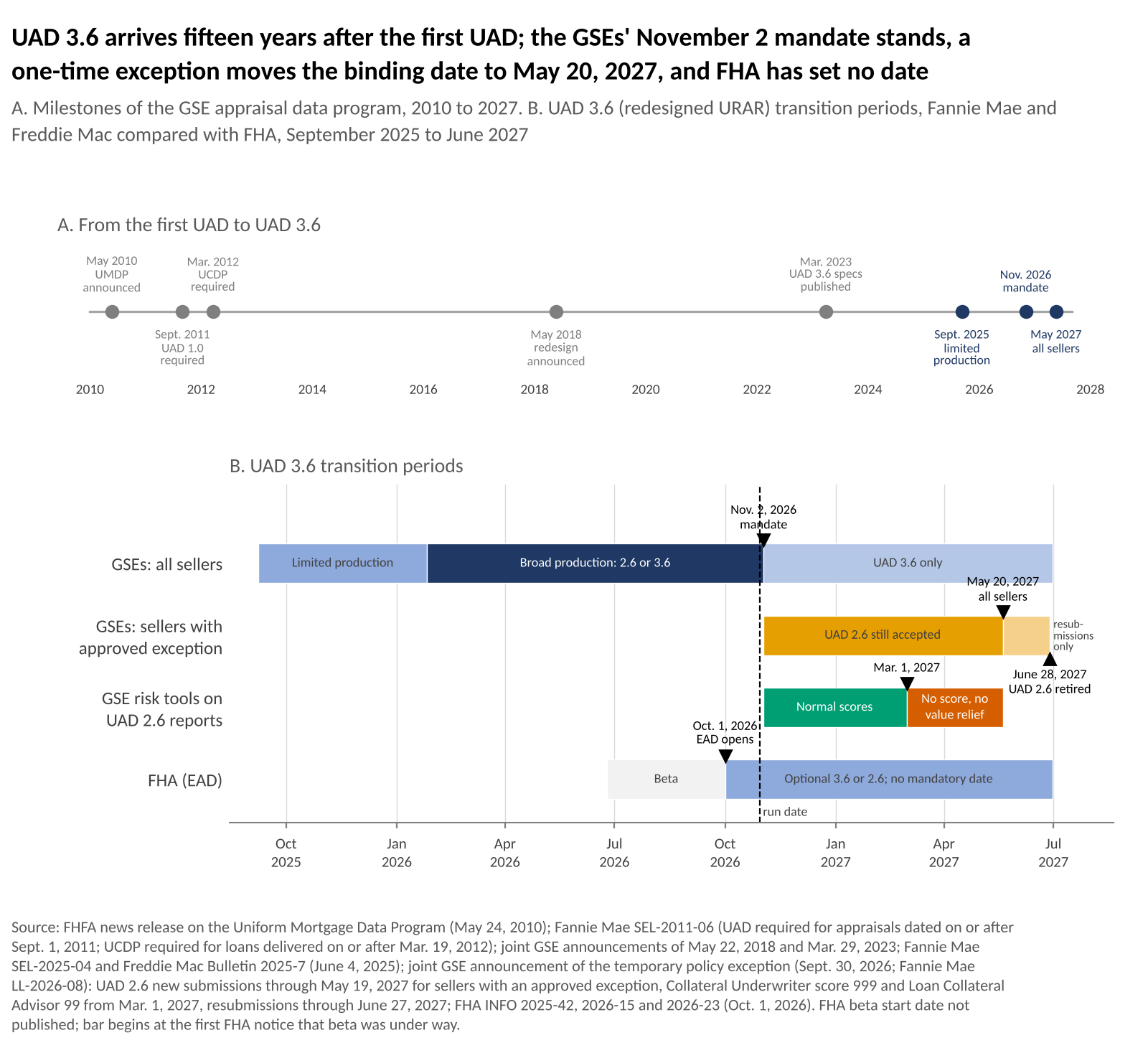
That infrastructure is now undergoing one of its most consequential changes in decades. At the direction of the Federal Housing Finance Agency (FHFA), Fannie Mae and Freddie Mac are moving the mortgage lending industry from a 15-year-old data standard to the updated Uniform Appraisal Dataset, commonly known as UAD 3.6. This transition, part of the Uniform Mortgage Data Program (UMDP), also introduces a redesigned Uniform Residential Appraisal Report (URAR). Appraisal forms used for decades—and originally designed to be completed by typewriter—are being replaced by a flexible, dynamic report built on a modern data standard.
A mandate is in place requiring the industry to transition to UAD 3.6 beginning November 2, 2026. The GSEs have also established a temporary exception process for approved sellers that need additional time to complete the transition. Under the exception, approved sellers may continue submitting UAD 2.6 reports for a limited period, although functionality begins to diminish on March 1, 2027, and policy and technology support is scheduled to end on May 19, 2027. The exception provides a short-term bridge for real-world circumstances; it does not replace or delay the mandate to move to the new standard.
FHA has indicated they are adopting the UAD 3.6 and have opened up their EAD (electronic appraisal delivery) portal to accept both the legacy UAD and the UAD 3.6. FHA has not indicated a mandatory adopt-by date.
The important story is therefore not simply that the appraisal form is changing. The industry is changing how property information is captured, exchanged, and ultimately used in the collateral underwriting process.
QUESTION 1
What is UAD 3.6, and why does it matter?
TELFORD
For years, residential appraisal reporting has relied on static forms corresponding to particular property and assignment types. UAD 3.6 changes that model.
The new Uniform Residential Appraisal Report (URAR) is dynamic. It adapts to the property and assignment, presenting the information appropriate to that appraisal analysis rather than forcing the analysis into one of several predetermined forms. Underneath the report sits an upgrade to the current UAD with a richer, more structured data model based on MISMO Reference Model 3.6.
That distinction matters.
An appraisal remains an appraiser's independent analysis and opinion of value. UAD 3.6 does not change that fundamental responsibility. What changes is the reporting, the quality (relative to standards for reporting), and utility of the information in the appraisal report surrounding that analysis.
Structured data standards can make appraisal information more consistent, clearer to interpret, and more useful for collateral-risk analysis. It can also create opportunities for better quality controls, more efficient workflows, and more sophisticated technology across the valuation process. This is increasingly important as AI-based technology advances and is dependent on reliable data. These have been central objectives of the appraisal modernization efforts from the GSEs.
Put simply, this is not about putting an old appraisal form on a newer screen. It is about creating a better language for property data throughout the mortgage ecosystem.
QUESTION 2
How is adoption progressing, and what have we learned?
TELFORD
Adoption is progressing meaningfully and not without some challenges. That should not be surprising for an industry transition involving thousands of participants, lenders, appraisers, appraisal management companies, loan-origination systems, appraisal platforms, and the GSE Uniform Collateral Data Portal submission infrastructure.
The industry took longer than anticipated to move from preparation into active production. That slower ramp-up has limited the amount of hands-on experience across some parts of the ecosystem, contributing to the uneven pace of adoption we are seeing today.
The most important lesson I have taken from the rollout is simple: readiness comes from experience. Each production file gives participants an opportunity to identify an issue, refine a workflow, and build confidence. That is why my message following the recent discussion at MBA Annual was: keep moving forward. Every appraisal flowing through the end-to-end ecosystem creates another opportunity for lenders, appraisers, AMCs and technology providers to learn.
The production experience supports that view. Recent activity as we approach the November 2nd mandate shows sharply increasing adoption and appraisal volume, while also showing an important difference between an organization successfully completing its first UAD 3.6 transaction and operating the new process routinely at scale.
We are also seeing the normal learning curve associated with a fundamental workflow change reminiscent of the changes when the first UAD was implemented in 2011. Appraisers are experiencing the greatest impact as they adapt how they collect property data and communicate their findings and observations in the redesigned dynamic appraisal report and we see that the efficiency in using the new UAD format returns as appraisers approach completing 10 or more reports.
QUESTION 3
What are the benefits of UAD 3.6?
TELFORD
The immediate objective is a successful industry transition. The more interesting question is what the new foundation allows us to do afterward.
A richer standardized dataset can improve consistency in how property characteristics are captured and communicated. It can make information easier for lenders and other participants to interpret and support more effective collateral-risk analysis. The GSEs have learned from their initial UAD work over the past many years, which was a retrofit of standardized data elements into the legacy appraisal forms.
Over time, structured data also creates an environment in which technology can do more of what technology does well: validate information, identify inconsistencies, reduce repetitive data entry, and help direct human attention toward the issues requiring analysis.
That becomes particularly interesting as artificial intelligence and other advanced technologies mature.
But modernization should not be confused with automating away professional judgment.
The appraiser’s true expertise goes far beyond physical data collection or data entry—it lies in market analysis, contextual judgment, reconciling competing data, and delivering a credible, independent opinion of value.
A better data architecture will amplify that expertise, not replace it.
BONUS QUESTION
What does this mean for the appraisal profession?
TELFORD
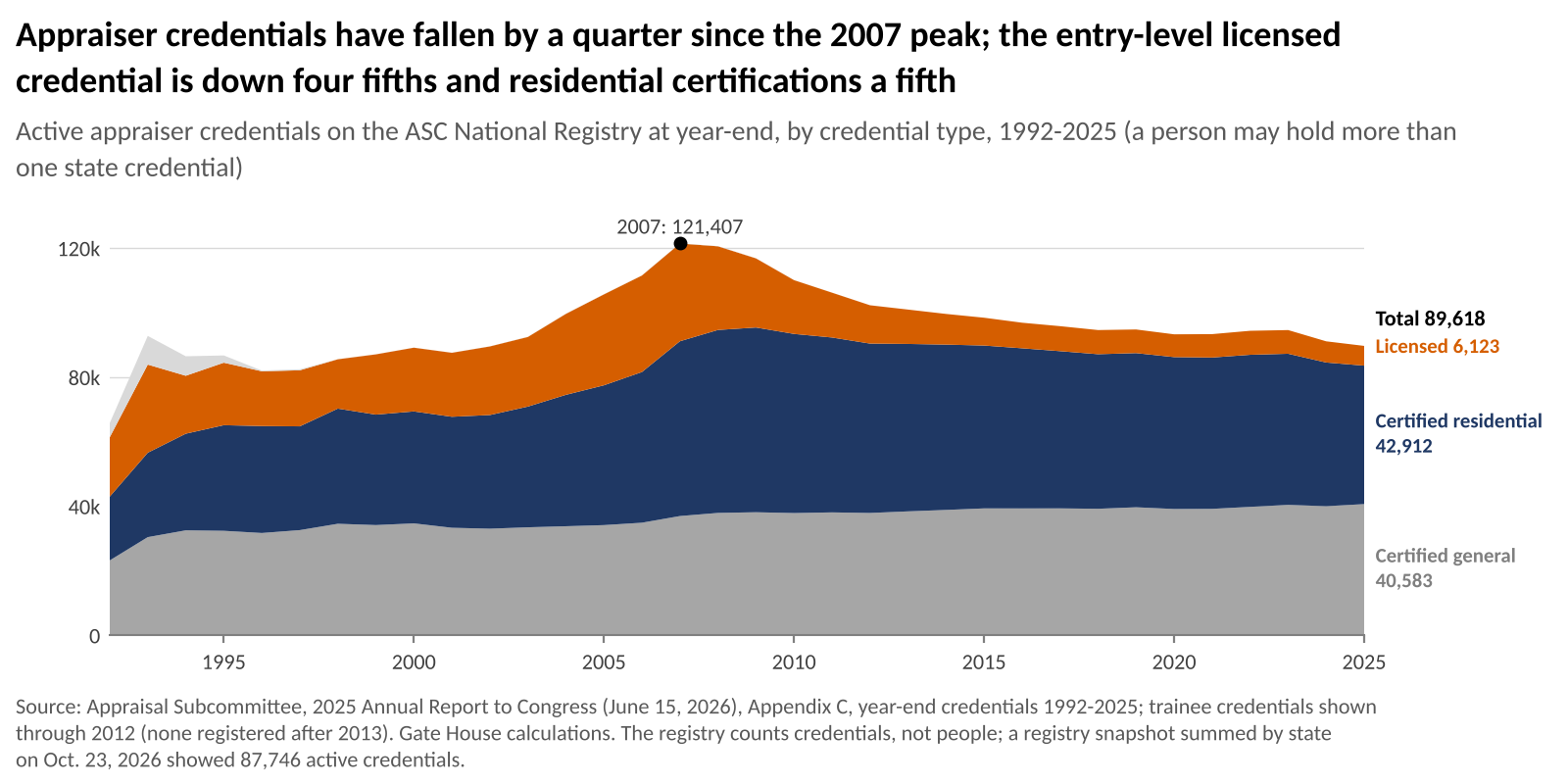
Any technology transition of this magnitude naturally raises questions about its effect on the professionals being asked to adopt it, including whether some appraisers will decide that another substantial change is not worth making and simply retire.
We should be careful about predicting widespread departures without evidence.
Production experience shows that UAD 3.6 requires an adjustment period. Initial assignments generally take longer as appraisers become familiar with the dynamic report, expanded data requirements, and new workflows. With repetition, however, those workflows begin to stabilize, and completion times decline from their initial transition peak.
A learning curve is not necessarily evidence that the future process will be less efficient. In fact, the longer-term opportunity is the opposite: allow technology to handle more repetitive collection, validation, and organization of data while allowing valuation professionals to concentrate more heavily on analysis and judgment.
Early benefits
Underwriters and borrowers have responded positively to the appraisal report’s updated layout and overall presentation. By making key information easier to locate, the redesigned report may reduce follow-up questions and requests for appraisers to explain analyses or address matters that were already covered but difficult to find in existing lengthy text addenda.
Support for the transition
Realizing those benefits will require the industry to support practitioners throughout the transition. Training, intuitive technology, clear guidance, and responsive support are not peripheral to appraisal modernization; they are essential to its success.
Ultimately, that is why the significance of UAD 3.6 extends beyond a compliance date or a redesigned appraisal report.
The real opportunity is to create a valuation ecosystem in which better data and better technology make professional expertise more useful, not less.
At Cotality, our mission is to ensure the entire valuation ecosystem transitions seamlessly. We have built comprehensive UAD 3.6 support directly into our end-to-end platforms—from appraiser desktop software, to lender and AMC workflow orchestration in our collateral management platforms and automated compliance validation before delivery to the GSEs. Cotality is focused on providing data and insights to our clients, and the additional standardization of data is an important part of allowing progress in this space. If we accomplish that, the beneficiaries will extend well beyond appraisers themselves. Lenders and investors will have more consistent information for evaluating collateral risk, technology providers will have a stronger foundation for innovation, and consumers will be served by a housing-finance system built on clearer, more usable property information.
The transition is not finished, but the industry has moved from preparing for UAD 3.6 to learning from it in production.
INSIDE VOICES

White House Executive Order
Issued on October 22, the “Decreasing Housing Costs for the American People” Order takes aim at mortgage costs and regulatory barriers, with initiatives to streamline mortgage insurance cancellation, expand alternatives to title insurance in refinancing, and lower rates on certain government-backed loans. A key opportunity may reside in the new Task Force on Manufactured Housing Innovation, to include co-chairs HUD Secretary Scott Turner and FHFA Director Bill Pulte, which has 180 days to recommend ways to modernize federal standards, reduce duplicative approvals, and leverage federal housing programs to expand affordable factory-built housing. Whether the task force translates its mandate into concrete changes in manufactured housing to expand more affordable housing remains to be seen.
FHA Build-to-Rent
On October 14, HUD Secretary Scott Turner announced a significant FHA policy change aimed at expanding rental housing supply by opening FHA multifamily mortgage insurance to qualifying build-to-rent (BTR) communities. Companion Mortgagee Letter 2026-12 makes these developments eligible under Section 221(d)(4) for new construction and Section 223(f) for acquisition or refinancing of recently developed properties, subject to underwriting and other requirements. The change removes a longstanding barrier for professionally managed communities of detached homes, duplexes and triplexes, including those using manufactured or modular construction. This move implements the administration’s push to reduce regulatory obstacles to housing production by creating sensible changes to FHA programs.
AI and the Next Cybersecurity Wake-Up Call
The recent “Bugmageddon” episode is a reminder that AI is becoming a double-edged sword in cybersecurity. Researchers used AI to uncover critical vulnerabilities in PHP, software that powers as much as 70% of the world’s websites, but the same technology can help malicious actors develop and deploy exploits at unprecedented speed. The risk is not simply more sophisticated attacks, it is a shrinking window between discovery, disclosure and exploitation, leaving organizations less time to respond. For mortgage lenders and other financial institutions, AI-related cyber risk deserves a place on the enterprise-risk agenda, with particular attention to patching vulnerable systems, third-party technology and incident-response readiness.
ROAD to Housing: An Opportunity to Modernize FHA Title I
The 21st Century ROAD to Housing Act creates several opportunities to expand manufactured housing as a source of affordable homes, including provisions that remove the permanent-chassis requirement, address barriers to modular construction, and strengthen FHA manufactured-housing financing. One of the less familiar but potentially consequential provisions involves FHA’s Title I Manufactured Home Loan Program, which finances homes that may be purchased without the underlying land, as well as land-and-home combinations. The law’s Title I provisions offer an opportunity to revisit loan limits, financing terms and other program features that have constrained lender participation and borrower access. The real test now shifts to HUD: administrative and program-design decisions will determine whether these statutory changes translate into a more functional secondary market, broader lender participation and meaningful new financing options for lower- and moderate-income households.
Escrow Advances: A Growing Servicing Cost to Watch
Rising property taxes and homeowners insurance premiums are creating a growing cash-flow challenge for mortgage servicers, who must advance funds when escrow accounts fall short. The Financial Stability Oversight Council reported that average monthly mortgage payments, including taxes and insurance, rose 34% nominally between March 2020 and June 2025. Meanwhile, LERETA’s 2026 survey found that 60% of borrowers experiencing payment increases were surprised by them, underscoring the potential for payment shocks and escrow shortfalls. For servicers, particularly nonbanks with more limited access to low-cost liquidity, these trends warrant closer attention to advance funding, escrow forecasting and the operational costs of managing rising tax and insurance bills.
THE GATE HOUSE INDEX
The Gate House Index and analysis is designed to provide insight into the status of FHA’s business at a moment in time and over a period of time, as well as other pertinent data points we’re following.
This month, we examine two changes to the inputs of every agency mortgage: the acceptance of FICO 10T and VantageScore 4.0 (VS4) as credit scores by the GSEs and FHA, and the move to the redesigned appraisal report, UAD 3.6. For credit score models, we show what scores and credit reports now cost, how the new scores differ from Classic FICO on the same borrowers, how well each model sorts risk, what lender choice of score costs the GSEs, and how many loans the new scores would add. For appraisals we show what the new report replaces, how many loans still get an appraisal, and FHA's share of that work.
Starting with a look at the credit model changes:
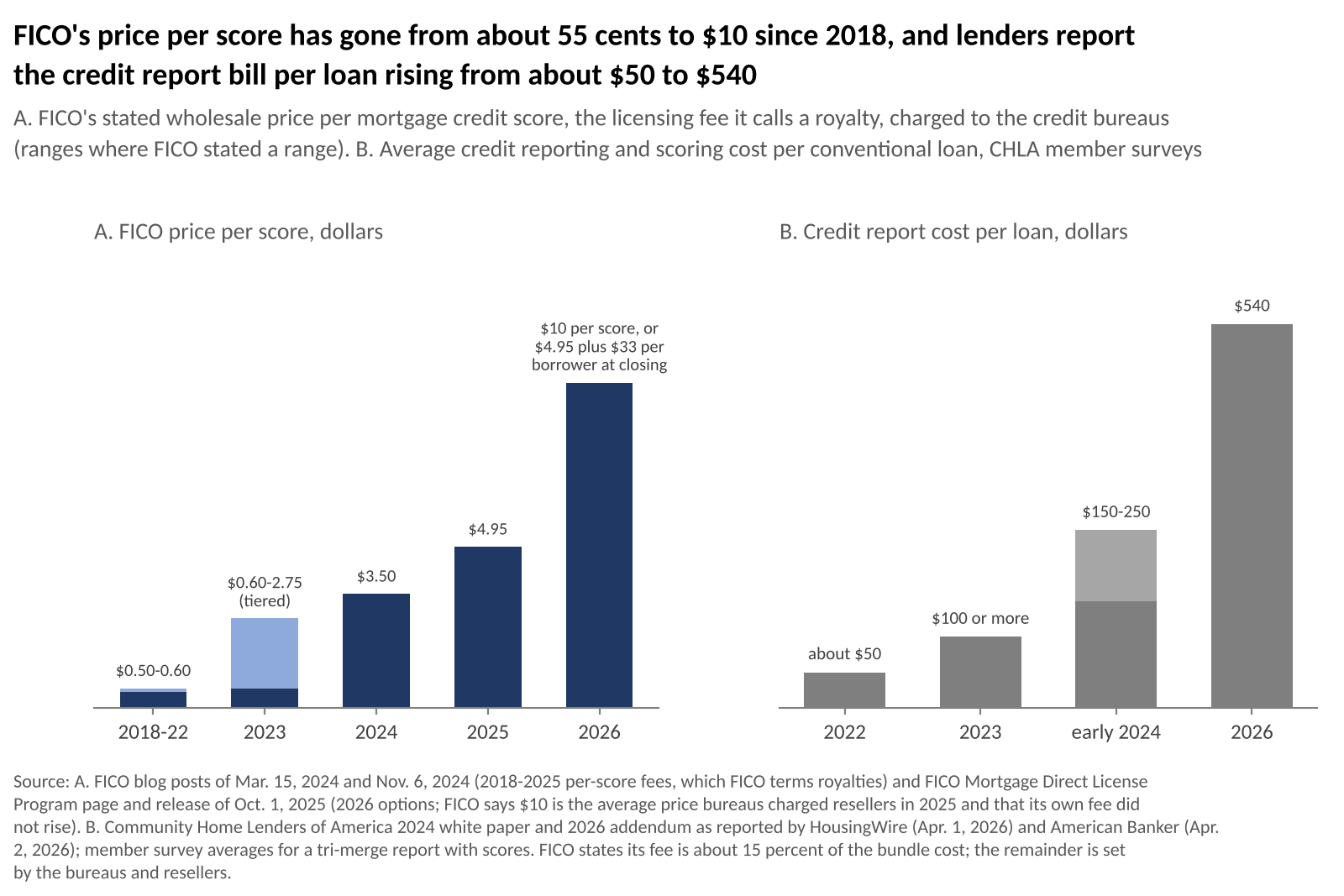
Cost is the argument FHFA has used for competition. FICO's per-score fee is a small part of the tri-merge bundle, as FICO points out, but it is the part that has risen most in percentage terms. The bureaus and resellers set the rest, and FHFA says it is considering a two-bureau report.
The next question is whether and how lender choice of models changes the credit score used for risk-based pricing on a loan. On the same loans, FICO 10T runs about 12 points above Classic FICO on average and VS4 about 13. The lift is largest for the lowest-scoring borrowers, 27 and 37 points at 580 to 619, and smallest at the top. One caution applies to all of the credit score charts: the analysis sample includes only loans that were approved under Classic FICO, so borrowers who would qualify only under a new model are not included.
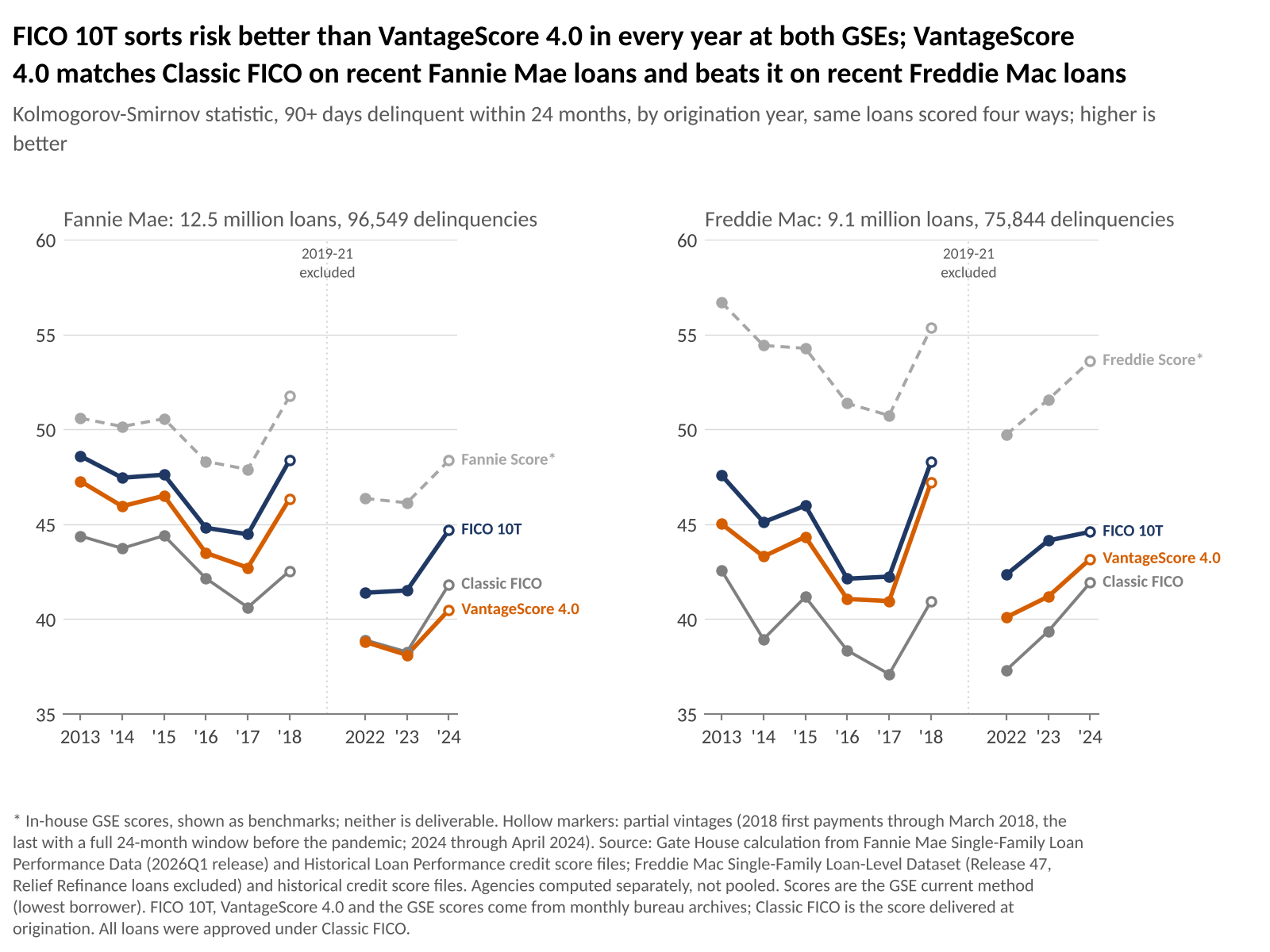
In the evaluation of credit risk, whether a model gives loans a higher score matters less than whether it sorts risk according to actual loan performance. Under 12 CFR Part 1254, Validation and Approval of Credit Score Models, the GSEs chose the KS (Kolmogorov-Smirnov) statistic, with loan performance defined as never 90+ days delinquent within 24 months, to approve new models. KS is calculated by ranking the loans from highest to lowest model score, then comparing, at each cutoff, the share of the loans that later went 90+ days delinquent that fall below it with the share of the loans that stayed current that fall below it. KS is the widest gap between those two shares. Higher KS is better. These loans were all approved under Classic FICO, and the pandemic years are left out.
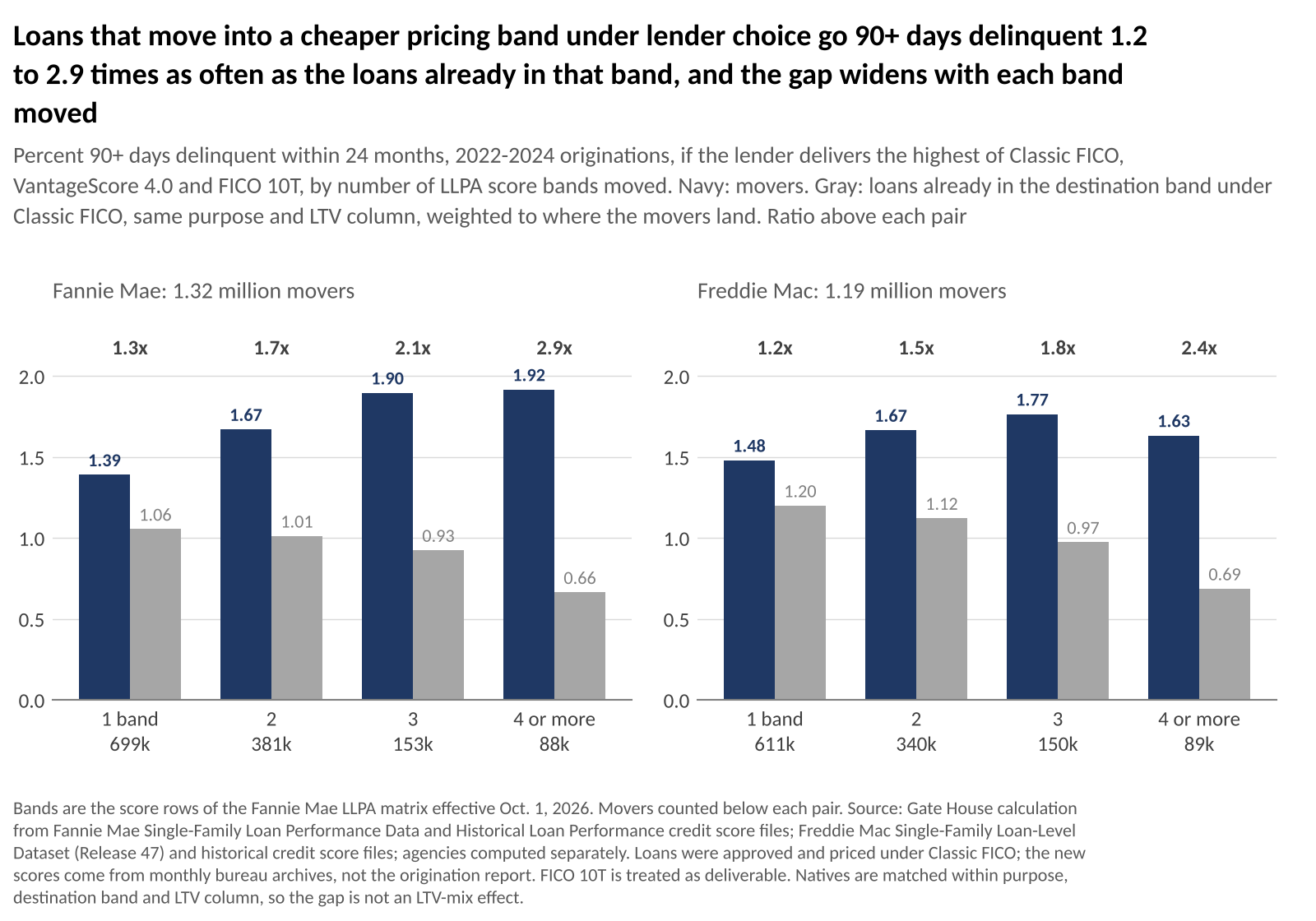
When the highest of multiple scores can be delivered, the loans that move into a cheaper pricing band carry more risk than the loans already there, and the gap widens with the distance moved. Allowing the highest of a borrower's several imperfect scores selects the model that flatters the borrower most. Letting lenders deliver the highest of Classic FICO, VS4 and FICO 10T on 2022-2024 originations would have moved about 1.3 million Fannie Mae loans and 1.2 million Freddie Mac loans.
How much is at stake? If every lender had delivered the highest of the three scores on its 2022-2024 loans, the LLPAs not collected would come to about $1.6 billion at Fannie Mae and $1.4 billion at Freddie Mac at today's grid. The grid itself was not changed on October 1, so the GSEs now accept VS4 scores without recalibration of any LLPAs.
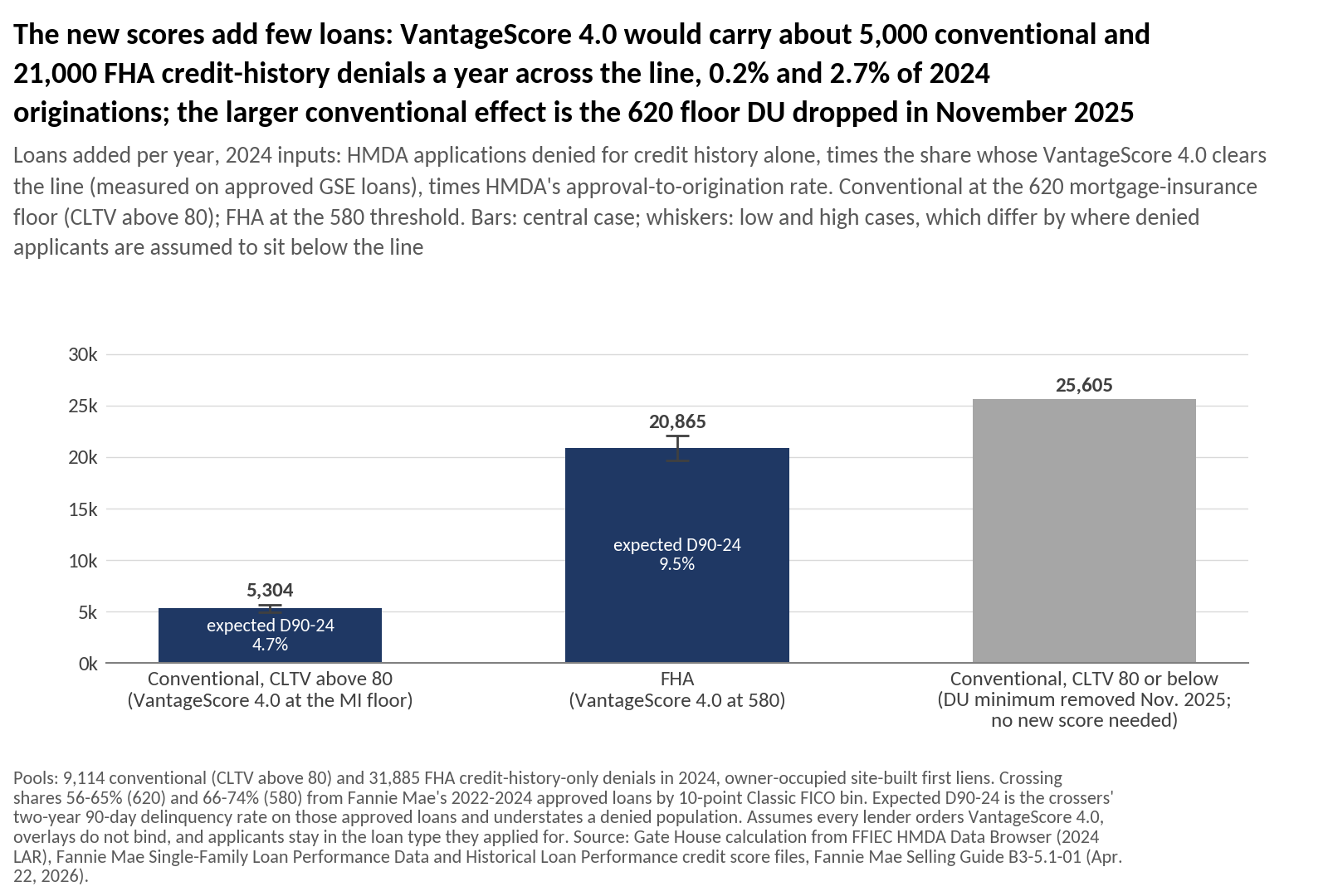
An additional question is how many borrowers a new score lets in. We start with the 2024 HMDA applicants denied for credit history alone, assume every lender pulls VS4 on every loan and that the MIs accept the same credit score models as FHA and the GSEs. We estimate that VS4 would have made up to about 5,000 conventional borrowers above 80 percent CLTV and 21,000 FHA borrowers eligible for approval in 2024, about 0.2 percent and under 3 percent of 2024 originations. Based on the performance of GSE loans within score bands that could become eligible, the new conventional and FHA loans would go 90+ days delinquent within two years at rates of 4.7 and 9.5 percent or higher. Below 80 percent CLTV there is no MI, and DU and LPA have no minimum score, so a new score changes nothing for those applicants.
Turning to the appraisal report:
The redesigned URAR is one dynamic report in place of more than a dozen forms (Table 1) that is delivered as MISMO data rather than a filled-in form.
Table 1. The forms retired on November 2, 2026 and what replaces them
| Fannie Mae form | Freddie Mac form | Report | In UAD 3.6 |
|---|---|---|---|
| 1004 | 70 | Uniform Residential Appraisal Report | property type 1-unit |
| 1004 Desktop | 70D | Uniform Residential Appraisal Report (Desktop) | valuation method Desktop |
| 1004 Hybrid | 70H | Uniform Residential Appraisal Report (Hybrid) | valuation method Hybrid |
| 2055 | 2055 | Exterior-Only Inspection Residential Appraisal Report | valuation method Exterior-only |
| 1073 | 465 | Individual Condominium Unit Appraisal Report | property type Condominium unit |
| 1073 Desktop | 465D | Individual Condominium Unit Appraisal Report (Desktop) | Condominium unit |
| 1073 Hybrid | 465H | Individual Condominium Unit Appraisal Report (Hybrid) | Condominium unit |
| 1075 | 466 | Exterior-Only Inspection Individual Condominium Unit Appraisal Report | Condominium unit |
| 2090 | none | Individual Cooperative Interest Appraisal Report | property type Cooperative unit |
| 2095 | none | Exterior-Only Individual Cooperative Interest Appraisal Report | Cooperative unit |
| 1004C | 70B | Manufactured Home Appraisal Report | construction method Manufactured |
| 1025 | 72 | Small Residential Income Property Appraisal Report | 2-4 units |
| 1004D | 442 | Appraisal Update and/or Completion Report | Restricted Appraisal Update Report; Completion Report (two standalone reports) |
| 1007 | 1000 | Single Family Comparable Rent Schedule | URAR Rental Information section |
| 216 | 998 | Operating Income Statement | Retired; not received through UCDP |
Source: Fannie Mae Selling Guide Announcement SEL-2025-04 and Freddie Mac Bulletin 2025-7 (June 4, 2025); GSE guide 'Functioning without Form Numbers: Mapping Legacy Forms to the URAR' v1.1 (June 2025); GSE UAD and Forms Redesign FAQs. The 1004MC market conditions addendum, not required since 2018, also has no UAD 3.6 equivalent.
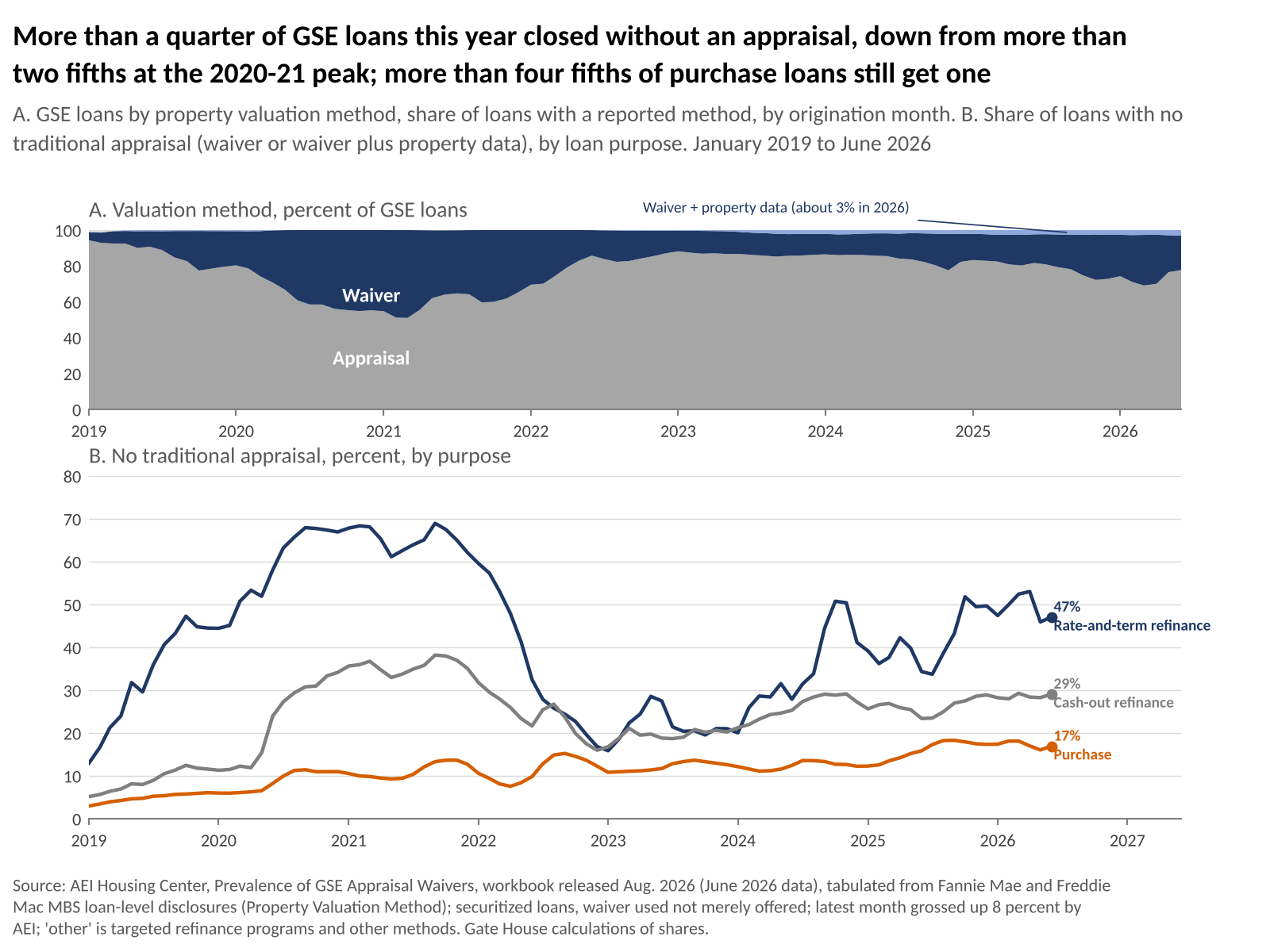
A high share of purchase loans, the bulk of today's volume, get an appraisal. The share of purchase loans using property-data alternatives, a trained collector plus a model, remains small. Many refinance loans close with an appraisal waiver.
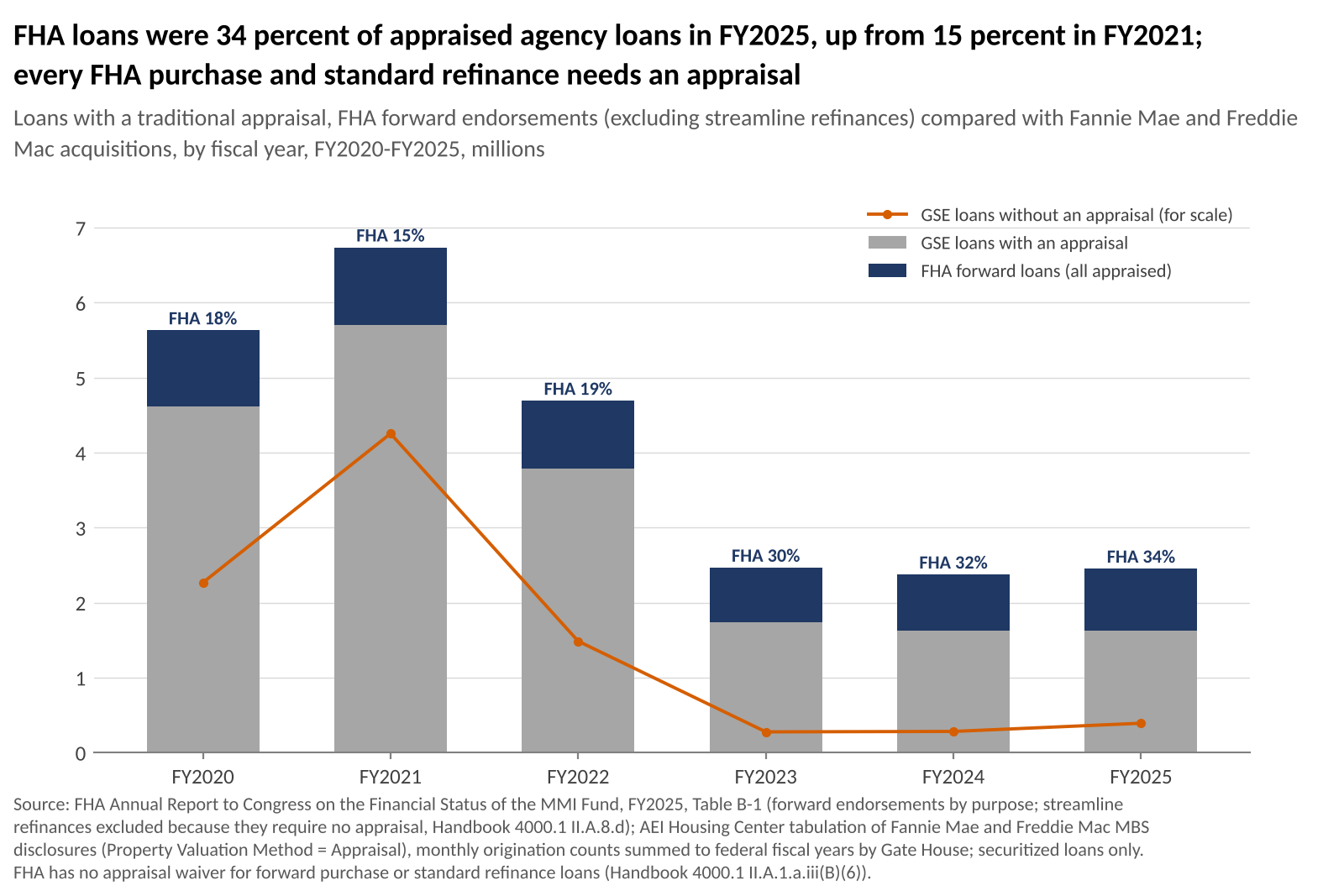
FHA's weight in the appraisal transition is larger than its market share because it has no waiver. Every purchase and standard refinance needs a roster appraiser's report. An FHA requirement for UAD 3.6, when it comes, will cover a third of combined GSE and FHA appraisals, and lenders selling to the GSEs will be producing UAD 3.6 reports long before then.
THIS MONTH IN HISTORY
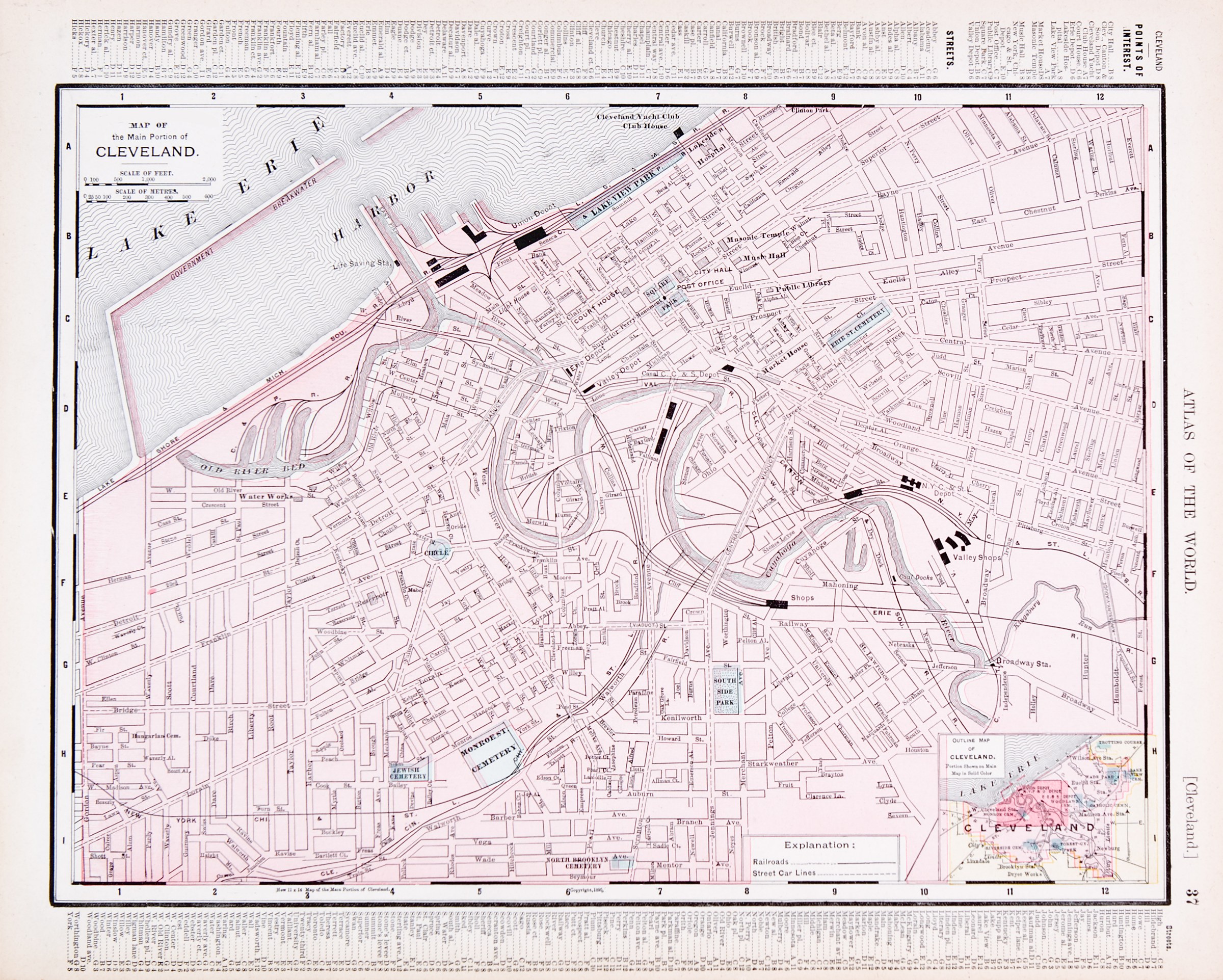
The Supreme Court upholds Euclid’s zoning ordinance and creates the legal foundation for single-family zoning
On November 22, 1926, the Supreme Court decided Village of Euclid v. Ambler Realty Co. and upheld a Cleveland suburb's ordinance dividing its land into six use classes, the most restrictive limited to detached single-family homes.
A lower court had struck down the ordinance, but Justice Sutherland, writing for a 6-3 majority, sustained it as a valid exercise of the police power. Drawing on the common law of nuisance, he treated zoning as nuisance control applied in advance, reasoning that "a nuisance may be merely a right thing in the wrong place,—like a pig in the parlor instead of the barnyard." The opinion also adopted the village's unfortunate view of the apartment house in a single-family district as "a mere parasite" on its surroundings, language that still colors the exclusionary zoning debate.
The decision gave every municipality constitutional cover for exclusive single-family districts, which still govern much of the residential land in most US cities. A century later, the fight over housing supply is being waged largely on the ground Euclid laid out.
FHA+ is published monthly by Gate House Strategies, a Washington, DC area-based advisory firm focused within the financial services, mortgage lending and servicing, community development, and public housing sectors. Contact us at FHAplus@gatehousedc.com